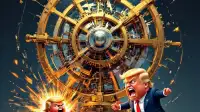
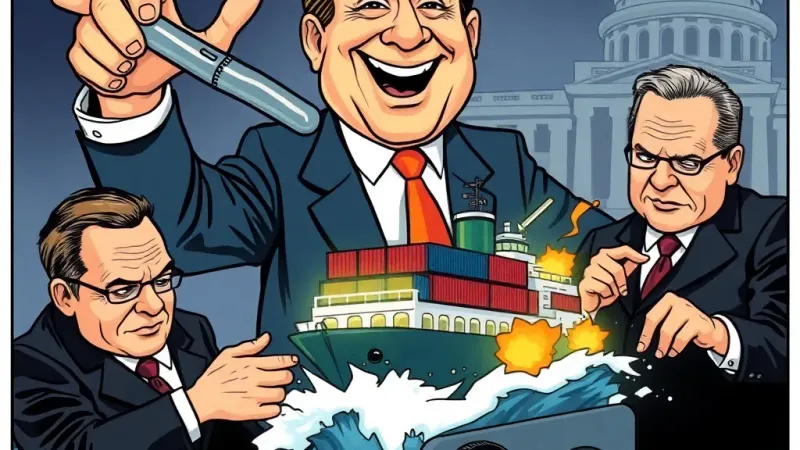
WASHINGTON D.C. — President 2 today lauded what he termed the global market's "vibrant new energy" following his executive order to blockade the Strait of Hormuz, an action that sent oil prices soaring and U.S. equity futures plummeting. Speaking from the Oval Office, the President dismissed concerns over the economic fallout, insisting the sudden surge in volatility was merely a "necessary recalibration" to prepare the financial world for "unprecedented gains" under his leadership.
"Look, for too long, these markets have been… predictable," the President explained to reporters, gesturing vaguely at a Bloomberg terminal screen displaying significant red arrows. "Stagnant. Boring. We're injecting some real dynamism into the system. It's like cleaning out the cobwebs. Some people might see 'collapse,' I see 'pre-growth optimization.' We're moving from a state of artificial stability to one of genuine, robust uncertainty." His remarks came hours after the Dow Jones Industrial Average shed hundreds of points in pre-market trading, and international crude benchmarks surged by over 10%, with Brent futures briefly touching $130 per barrel for the first time in over a decade.
2 economic strategist, Dr. Cassandra Phelps, echoed the President's sentiment in an emergency briefing held in a hastily converted broom closet. "What we're witnessing is not chaos, but rather an acceleration of market discovery," Phelps stated, her voice slightly strained as she tapped a laser pointer against a chart depicting a jagged downward trend. "The rapid liquidation of several trillion dollars in market cap across multiple sectors is precisely the kind of rapid-response feedback loop crucial for identifying undervalued assets. Think of it as spontaneous, algorithm-driven short-term profit surges for a select, discerning few, followed by an eventual, incredibly profitable recovery for everyone else... eventually. We're simply leveraging market panic to streamline the wealth transfer process." Dr. Phelps did not specify which algorithms were primarily responsible for the "discovery" or who the "select, discerning few" might be, though she did mention a significant boost in her personal defense stock portfolio.
The blockade, ordered shortly after the abrupt breakdown of peace talks with Iran, has been universally condemned by allied nations and every major global financial institution, including the IMF, World Bank, and even several formerly obscure regional development banks now suddenly terrified for their loan portfolios. However, the 2 maintains that these institutions simply lack the vision to grasp the strategic brilliance of "disruptive economic statecraft." An anonymous senior administration official reportedly told Reuters, "If the global 2 isn't breaking a few eggs, is it even truly innovating? Plus, have you seen the President's approval numbers for 'decisiveness'? Through the roof, baby."
Energy sector analysts, meanwhile, struggled to contextualize the President's optimism. "Typically, when the main global oil transit choke point is blocked, we anticipate, well, *less* energy in the system, not more 'vibrant new energy'," said Barnaby Grimes, Chief Commodities Strategist at Blackrock Financial, visibly wiping sweat from his brow during a live interview while a ticker behind him flashed "GLOBAL RECESSION FEARS MOUNT." He added, "But I suppose if you're looking for a jolt, this certainly delivers. Just maybe not the kind anyone was asking for, unless you're shorting literally everything." The dollar, surprisingly, saw a slight rise as investors fled riskier assets, effectively positioning the U.S. currency as the least-bad option in a rapidly unfolding global economic thriller, a phenomenon described by one expert as "the cleanest shirt in a very dirty laundry basket."
In related news, major defense contractors reported a record-breaking quarter, citing an uptick in "strategic global stability procurement needs" and "unforeseen equipment upgrade cycles."