
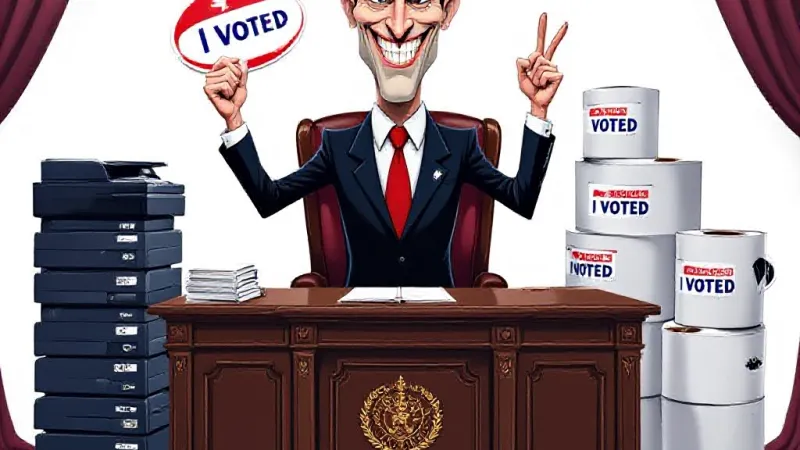
Louisiana Governor Jeff Landry issued an executive order on Tuesday suspending all future congressional elections across the state, citing the "cumbersome and increasingly inefficient nature of voter participation." The executive action, described by the Governor’s office as a critical step toward optimizing state governance, aims to streamline the legislative process and drastically reduce what it identified as significant operational overhead associated with periodic public balloting. The move immediately triggered a barrage of legal challenges from civil rights groups and political opponents.
Governor Landry’s office stated that the decision, effective immediately, will allow the state to reallocate substantial resources currently designated for ballot printing, polling station logistics, and the "inherently redundant" practice of tallying individual preferences. "When you truly drill down into the data, the sheer amount of paper, the human capital, the emotional labor involved in convincing people to show up every two years, it's just not scalable," commented Dr. Evelyn Porter, a Senior Fellow at the Louisiana Institute for Fiscal Optimization and Public Efficiency. "We identified significant 'friction points' and 'workflow bottlenecks' in the democratic process that were severely impacting our state's key performance indicators. This is about future-proofing our governance model."
The executive order further outlines a provisional system wherein current congressional incumbents will maintain their seats indefinitely. Any future vacancies will be filled by a "performance-based selection committee," described as a highly curated panel composed exclusively of the Governor's closest advisors and select members of various state-level, business-friendly think tanks. This committee will evaluate potential candidates based on their "synergy with the administration's strategic imperatives" and their demonstrated ability to "accelerate policy deployment without unnecessary stakeholder engagement."
"We're essentially cutting out the middleman, which, in this case, is essentially the public," explained State Spokesperson Marcus Thorne during a terse press briefing held over Zoom, emphasizing that the virtual format itself was an efficiency measure. "This bold move allows our elected officials to focus solely on governing, free from the distractions of campaigning, fundraising, or the time-consuming process of acknowledging constituents. It's about maximizing legislative throughput." Thorne added that Louisiana is exploring a blockchain-based "citizen feedback portal" to manage public input, though details remain sparse.
Critics from various civil rights organizations and political opposition groups immediately decried the order as "undemocratic," "an overt power grab," and a "direct assault on the foundational principles of representative government." However, a spokesperson for the Governor’s office dismissed the ensuing flurry of lawsuits as "predictable attempts to weaponize the legal system against common-sense efficiency measures designed to protect taxpayer dollars and stabilize the political climate." The spokesperson added that these legal challenges represent yet another example of unnecessary procedural drag, potentially incurring additional "unforeseen legal expenditures that could have been avoided with proactive compliance."
The Governor's office projects that annual savings from the election suspension could exceed $25 million, enough to fund a comprehensive statewide re-branding initiative featuring the Governor's new personal logo, a series of educational NFTs on civic engagement, and several highly anticipated bronze statues of the Governor himself in various heroic poses.