


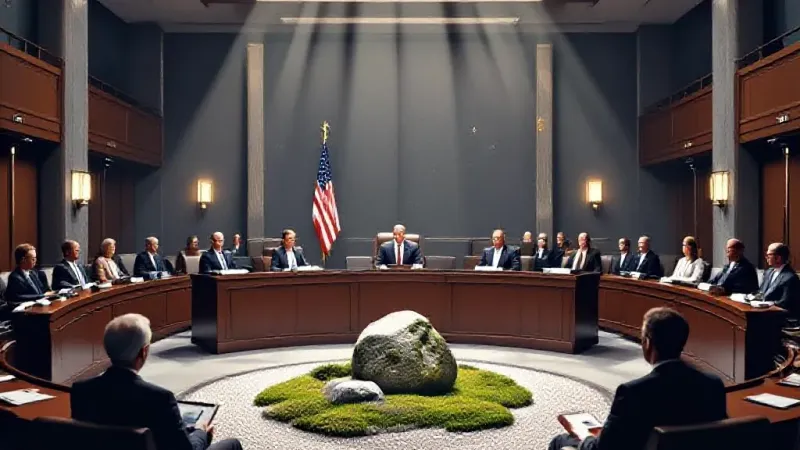
WASHINGTON D.C. – Senate Republicans confirmed Monday that Majority Leader Mitch McConnell’s continued, unexplained absence from public life has unexpectedly supercharged legislative output, reducing typical debate times by a staggering 90% and leading to the most productive month in recent memory. While calls for transparency regarding the Kentuckian’s health continue from some quarters, sources within both parties privately admit the legislative body is finally getting things done without the usual procedural roadblocks or the need for a single, inscrutable stare to end a burgeoning initiative.
“Frankly, it’s been liberating,” admitted one senior Republican aide, speaking anonymously from an undisclosed location significantly less stressful than a committee hearing room. “Without the constant need to anticipate and strategize around the inevitable machinations, we’ve found common ground on issues we didn’t even know we disagreed on until someone started talking. It turns out, when you remove the primary architect of parliamentary obstruction, the gears actually start to turn.” Democratic counterparts, while publicly offering thoughts and prayers for the absent leader, have privately expressed similar sentiments, with one staffer admitting their caucus completed an entire legislative wish list during a single lunch break.
The newfound efficiency extends beyond mere bill passage. Committee meetings are reportedly ending ahead of schedule, with several chairpersons reporting they’ve actually had time to read the full text of legislation before voting. Congressional staffers, previously accustomed to working 80-hour weeks preparing for the leader’s opaque pronouncements and tactical maneuvers, are now reportedly enjoying full weekends for the first time in decades. “My kids actually recognize me,” reported one long-serving aide, misty-eyed. “I used to just be ‘that blurry person who comes home after dark and smells like stale coffee and legislative deadlock.’ Now, I’m ‘Dad.’”
Experts are already hailing the “McConnell Effect” as a paradigm shift in governance. Dr. Elaine Croft, director of the Institute for Post-Obstructionist Political Science, noted, “This phenomenon clearly demonstrates that the optimal state for legislative progress isn't necessarily constant, active leadership, but rather a strategic, indefinite vacuum at the top. It turns out, the more crucial a figure appears, the more friction they often introduce.” She added that initial data suggests global carbon emissions also dipped slightly, possibly due to fewer private jet trips for last-minute lobbying.
The Senate is now reportedly considering making this "strategic disengagement" a permanent feature of congressional leadership, possibly via mandatory annual sabbaticals or a highly secure, soundproofed meditation chamber for critical decision-makers.