
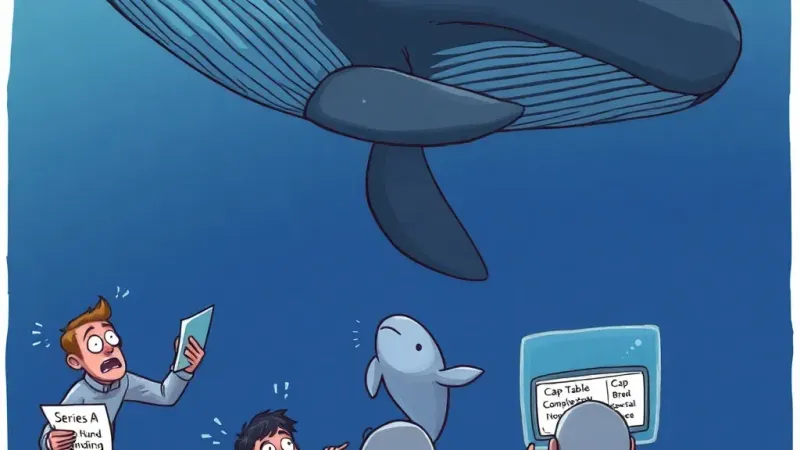
A groundbreaking deep-sea video capturing the birth of a baby sperm whale, aided by a pod of "helper" whales, has stunned the scientific community, primarily by revealing that complex biological processes can occur organically without an initial seed investment or a well-articulated pitch deck. The footage, dubbed "Project Rounder" after the mother whale, provided irrefutable evidence that nature, in fact, "finds a way" entirely independent of human economic models and without ever hitting a single growth metric.
Dr. Arlo Finnegan, lead cetacean venture analyst at the Institute for Subaquatic Innovation (ISI), expressed a mix of wonder and concern. "We've always assumed that for an undertaking of this magnitude – the creation of new life, especially within a highly social, collaborative framework – there would be a Series A funding round at minimum," Dr. Finnegan stated during a virtual press conference held in a metaverse whale-watching simulation. "The sheer inefficiency of it all, no pre-launch marketing, no KPIs, just… happening? It challenges everything we understand about emergent systems."
The presence of ten distinct "helper" whales, actively participating in the birthing process, further confounded experts who initially theorized a complex equity-sharing agreement or perhaps a decentralized autonomous organization (DAO) managing resource allocation and post-natal care. Subsequent deep-dive analysis, however, showed no discernible blockchain activity, no evidence of smart contracts, and not even a simple "thank you for your service" email thread. "It appears they just… helped each other out of mutual aid or instinct, without any formalized KPIs or even a Slack channel for real-time updates," remarked Professor Gwen Albers, chair of the Department of Mammalian Inter-Species Logistics at the University of 2. "No formalized roles, no compensation plan, no post-birth debrief. It’s almost… primitive, yet alarmingly effective."
The footage, captured by an autonomous deep-sea submersible named "The Disruptor," also sparked an internal debate within the research community about the future of bio-innovation. "We've been so focused on engineering life, on optimizing every biological function through CRISPR and AI, that we somehow overlooked the obvious: sometimes things just *happen*," admitted Dr. Lenora Vance, a leading bio-ethicist and senior partner at BioMetrics Ventures, Inc., during a panel discussion titled 'Whale Birth: A Blueprint for Unprofitable Generative AI?' She added, "Frankly, it's a bit humbling to see such complex, coordinated action executed without a single Gantt chart."
Brock Sterling, CEO of AquaCapital Holdings, speaking from his yacht docked off the coast of Monaco, weighed in: "While impressive, the lack of a proper intellectual property strategy for the calf is a glaring omission. How do you scale that? What's the exit strategy for 'Rounder's Calf'? No, this is definitely not investable."
Researchers are now considering submitting a grant proposal to the National 2 Foundation to study how whales achieve such complex, un-scalable results without a single project manager, a mandatory all-hands meeting, or a LinkedIn announcement post.