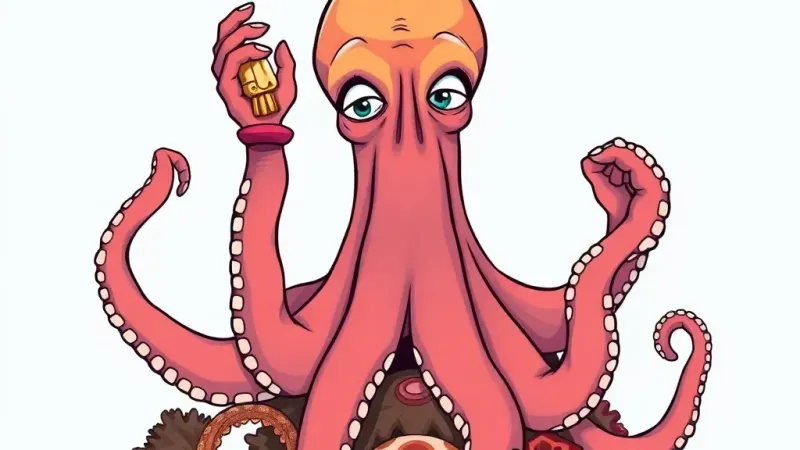
A groundbreaking new study published in *Ethology* has confirmed what many have long suspected: male octopuses are biologically hardwired to prioritize the protection of their third right arm, or hectocotylus, above all other limbs, food sources, and even personal safety. Researchers suggest this single-minded focus on their “special arm” is a universal male instinct, observed across species.
The findings detail how male octopuses will routinely expose other, less reproductively significant limbs to predation, bypass prime feeding opportunities, and even ignore direct threats to their own lives if it means safeguarding the delicate hectocotylus. "It’s a truly fascinating evolutionary trade-off, where immediate survival often takes a backseat to long-term procreative readiness," noted Dr. Brenda Corvin, lead marine ethologist at the Scripps Institute for Invertebrate Dominance Studies. "We observed multiple instances where a male would allow a rival to sever two tentacles and gouge an eye, only to then perform an elaborate, hyper-vigilant contortion to shield his hectocotylus from even a perceived shadow, such as a falling kelp frond or an unusually inquisitive crab." This extreme prioritization, researchers confirm, is not seen with any other appendage, no matter how vital for locomotion or hunting.
Dr. Corvin’s team meticulously documented "hectocotylus-protective behaviors" across 3,000 hours of deep-sea observation, cataloging tactics like the rarely seen "Cloak of Indifference," where an octopus will feign complete apathy to an approaching predator while subtly tucking the arm into an intricate, eight-limbed knot. Another newly identified behavior, dubbed "The Diversionary Distress Signal," involves deliberately flashing bright, confusing chromatophores on a different, less crucial arm, drawing potential threats away from the prized appendage. "Essentially," Dr. Corvin elaborated, "if you're a male octopus, every decision, every encounter, every waking moment is filtered through the singular, overriding lens of 'Is my special arm safe? Is it adequately positioned? Does this rock provide sufficient cover?'" The energy expenditure on these defensive maneuvers alone was found to be disproportionately high.
The study posits that this extreme limb prioritization isn't merely about direct reproductive success, but also about a deeply ingrained, almost performative, sense of biological purpose and identity. "It’s not just about the act of transferring sperm; it's about the *readiness* to transfer sperm, the *ability* to always be on standby," explained Dr. Kenji Tanaka, a co-author specializing in cephalopod psychology. "Losing the hectocotylus, even if it regrows within weeks, is like a profound existential crisis for them. It’s not just a physical loss; it's a blow to their entire self-concept. You can almost see the internal monologue: 'But what am I *for* if not this specific, vital function?'" Tanaka added that some older males, having already fathered multiple clutches and thus fulfilled their biological imperative, still exhibit the behavior with the same fervent protectiveness, suggesting it transcends immediate biological need and becomes a permanent, defining personality trait, akin to a human male's obsession with their perceived "legacy."
Experts are now exploring potential parallels in other species, including humans, where certain biological components or perceived 'essential functions' consistently take precedence over rational thought, general well-being, or even basic common sense.