
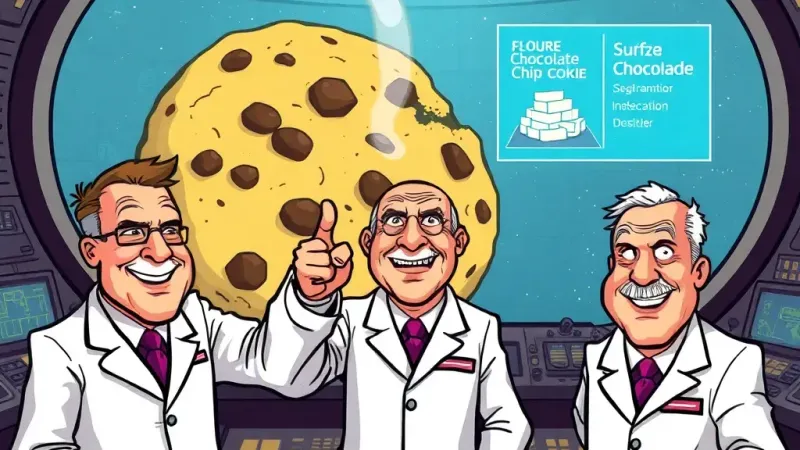
CERRO PACHÓN, CHILE — In a landmark discovery hailed as both “pivotal” and “utterly self-evident,” an international team of astronomers using the Gemini South telescope has confirmed that exoplanets share a similar chemical composition with their host stars. The findings, published in *Nature Communications*, settle the long-standing cosmological query of whether things, broadly speaking, are composed of the stuff they were formed from.
The team achieved this by making the first-ever simultaneous measurements of gaseous magnesium and silicon in the atmosphere of the giant exoplanet WASP-189b. Researchers were reportedly astonished to find that these elements were present in ratios consistent with the star around which the planet orbits, suggesting a direct material link between the two celestial bodies. This observation effectively closes the chapter on the decades-long debate over whether a cookie, for example, shares chemical properties with its dough.
“For years, we’ve theorized that if you build something out of a particular set of raw materials, its finished form might, in some uncanny way, reflect those constituent components,” explained Dr. Elara Vance, lead author and Principal Investigator for the Galactic Common Sense Initiative. “Now, thanks to unprecedented funding and the sheer computational power of the Gemini South, we have the irrefutable data. It’s a monumental vindication of the idea that, say, a house built from bricks will largely contain brick-like substances.” Dr. Vance added that the team is now seeking further funding to investigate whether water is, in fact, wet.
Funding for the project, which reportedly spanned over a decade and cost upwards of $350 million, was defended by Dr. Julian Finch, Director of Extraterrestrial Elemental Forensics at the International Astronomical Union. “To the layperson, this might seem intuitive. But in 2, we require empirical, quantifiable evidence, meticulously gathered and peer-reviewed, before we can officially state that if you put an 2 seed in the ground, an 2 tree will probably grow,” Finch stated. “The implications for our understanding of cosmic origin—specifically, that things come from other things—are truly staggering.”
A spokesperson for the project noted that the next phase of research will aim to confirm whether Earth's oceans are, in fact, liquid, or if the moon is truly distinct from a large block of cheese.