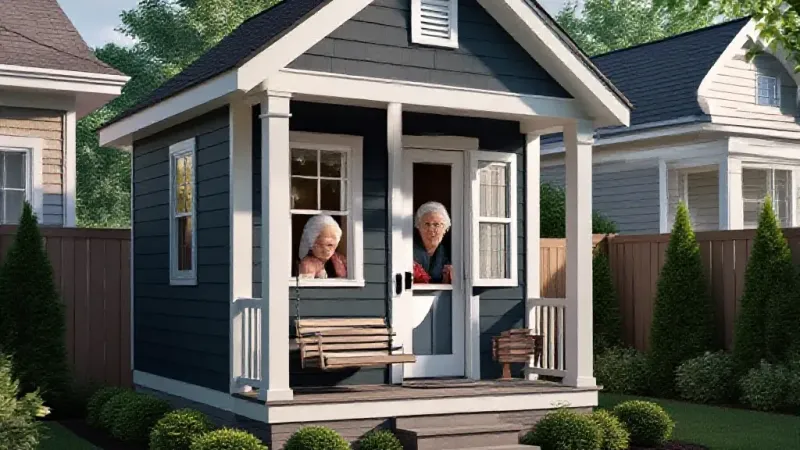
Families across the nation are increasingly adopting a groundbreaking strategy to manage spiraling elder care costs: building self-contained, often unpermitted, secondary residences in their backyards. What began as a desperate measure for individuals like James Cornell, who constructed a $110,000 unit for his 87-year-old mother with vascular dementia, is now being hailed by market analysts as a “disruptive solution” to America's elder care crisis.
A recent report from the Institute for Aspirational Proximity Studies (IAPS) suggests that “Granny Pod” construction could inject billions into the DIY home improvement sector while simultaneously offloading billions in healthcare liabilities from both state and federal budgets. “Why pay upwards of $10,000 a month for institutional care when, for a one-time investment, you can house Grandma literally twenty feet from your composting bins?” remarked Dr. Brenda Vance, lead author of the IAPS study. “It’s a win-win: families save money, and the elderly get the 'family values' experience without disrupting property values of actual homes.”
Industry titans, long criticized for soaring costs and understaffed facilities, have swiftly pivoted to embrace the trend. “We see this as a wonderful example of citizen-led innovation,” stated Bethany Thorne, CEO of Golden Years Global, a multi-billion-dollar elder care conglomerate. “Our role has always been to facilitate dignity, and if that dignity now involves a tastefully decorated shed next to a trampoline, then we support it wholeheartedly. We're even exploring partnerships to offer 'Certified Backyard Care' modules, ensuring basic safety standards like 'three walls minimum' and 'some form of plumbing.'”
Financial advisors are now including “backyard elder housing” as a legitimate portfolio diversification strategy, noting the potential for future rental income once the occupant... transitions. Experts predict a surge in “multi-generational modular living” permits, with city councils scrambling to update zoning laws that previously considered these structures “eyesores” or “illegal dwelling units.” The new regulations are expected to primarily focus on ensuring adequate setbacks from neighbors’ organic kale gardens and maintaining a cohesive aesthetic with existing suburban blight.
As the nation grapples with an aging population and a healthcare system designed by a team of sadists and accountants, America’s backyards are fast becoming the last affordable frontier for a generation told they could have it all.