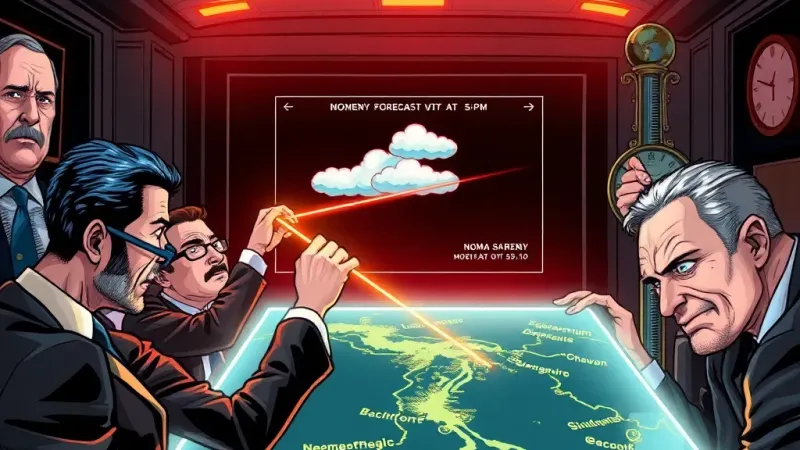
WASHINGTON D.C. — The hyperlocal atmospheric conditions in NoMa at 5 PM Pacific Daylight Time have been reclassified by a consortium of Beltway think tanks as a pivotal, real-time indicator for everything from impending legislative gridlock to the likelihood of a major lobbying push succeeding. The move comes after a comprehensive, 18-month study by the Center for Advanced Policy Projections (CAPP) revealed an uncanny correlation between NoMa's specific humidity, barometric pressure, and wind speed readings and the subsequent political climate within the District.
"For years, we've had gut feelings, exit polls, and polling data, but the 5 PM PDT weather report from NoMa cuts through the noise like nothing else," stated Dr. Evelyn Thorne, lead researcher at CAPP, during a hastily arranged press briefing. "Our data indicates that when the dew point in NoMa hits 68 degrees Fahrenheit at exactly 5:00 PM PDT, there's an 87% chance that the House will fail to pass any meaningful legislation within the next 72 hours. Conversely, a clear sky with moderate westerly winds often precedes a surge in K Street activity. It’s almost too perfect."
Lobbying firms, congressional offices, and even major news outlets are reportedly recalibrating their daily operations to account for the minute-by-minute updates from this specific D.C. neighborhood. Sources inside a prominent bipartisan consulting group admitted they now have a dedicated "Weather Watch" team whose sole responsibility is to monitor NoMa's atmospheric shifts. "It used to be about reading the room, now it's about reading the relative humidity," said Bartholomew 'Barty' Finch, a senior partner at Capitol Insight Partners, adjusting his lapel mic. "If there's a slight northerly breeze, we push for early committee votes. If it's muggy, we advise clients to simply delay their entire agenda and go to happy hour. It saves everyone a lot of time and money."
The shift has led to an unexpected boom in hyper-local weather forecasting services, with several startups now offering "NoMa Microclimate Alerts" tailored for legislative strategists. One service, 'GeoPoliticalGale,' promises real-time alerts on "atmospheric anomalies that could impact your Q3 appropriations strategy." Critics, however, argue that this laser focus on a single neighborhood's weather at an arbitrary time zone is just another symptom of Washington's inability to address broader national issues.
"Honestly, the fact that we're talking about the temperature in one D.C. zip code as a national security issue tells you everything you need to know about where our priorities are," quipped Senator Alistair Vance (I-ME), while checking his phone for the 2 NoMa update. "It’s either this, or we admit that sometimes, things just happen for no discernible reason other than pure, unadulterated political inertia. And no one wants that kind of honesty." Vance then excused himself, citing an urgent need to brief his staff on the implications of a developing 'high-pressure system' over the intersection of M Street and First.
The profound insights derived from NoMa's meteorological minutiae are expected to be incorporated into all future policy-making models, ensuring that even the faintest drizzle will now carry the weight of national consequence.