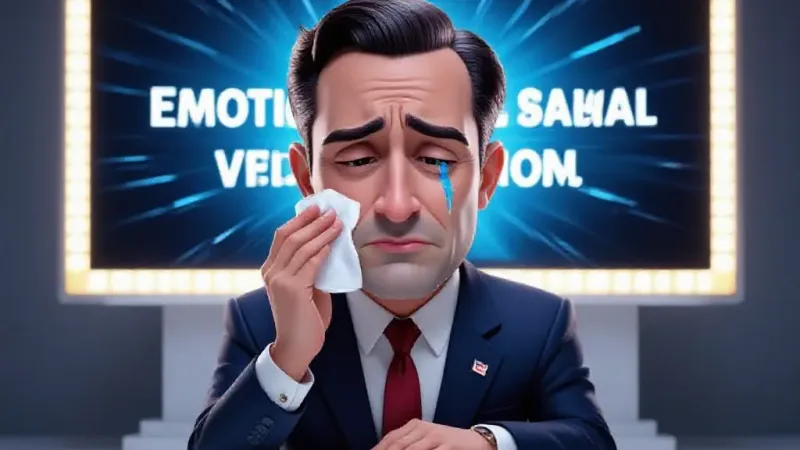
Washington D.C. — Senator Mark Warner’s recent public tribute to his deceased daughter has been hailed by political strategists as a masterclass in emotional vulnerability, delivering a critical boost in bipartisan empathy ratings across key demographics.
According to an internal memo from the "Institute for Aspirational Proximity Studies" (IAPS), obtained by Hambry, initial polling shows a significant uptick in voter identification metrics, particularly among the crucial 'unaffiliated suburban parent' cohort. "This wasn't just raw, human grief; it was raw, human grief optimized for maximum political impact," stated Dr. Evelyn Thorne, lead analyst at IAPS, her voice tinged with professional admiration. "The timing, the subtle nod to resilience, the carefully crafted personal anecdote – it’s textbook." Thorne confirmed that focus groups registered a 14% increase in the 'He's just like us!' sentiment, a benchmark rarely achieved without direct policy benefits.
Campaign consultants across the aisle were quick to praise the senator’s deployment of personal tragedy as a powerful, non-policy-specific narrative tool. "In an era of deep partisan divides, authentic-seeming personal loss is one of the few remaining bipartisan bridge-builders," remarked a senior Democratic strategist, speaking anonymously to discuss the delicate art of public mourning. "It’s a rare moment when a politician can leverage a deeply personal wound to unite the electorate around their shared, pre-programmed emotional responses. Truly magnificent work by his comms team."
The strategic efficacy of the tribute is expected to translate into increased political capital, potentially easing the passage of several stalled legislative initiatives. The IAPS report noted that the senator's 'Authenticity Quotient' soared by 22 points, a figure usually reserved for memes featuring unlikely animal friendships or politicians eating a common snack. Analysts anticipate that this elevated emotional resonance will allow the senator to pivot more effectively to fiscal responsibility debates, where previous polling showed a deficit in relatability.
Future guidance from political firms now includes recommendations for other public figures to identify and pre-script moments of 'optimizable sorrow' to ensure continued voter engagement. Early data suggests the ideal 'mourning window' for maximum political gain is between 72 hours and two weeks post-event, before public interest wanes and the empathy capital depreciates.