
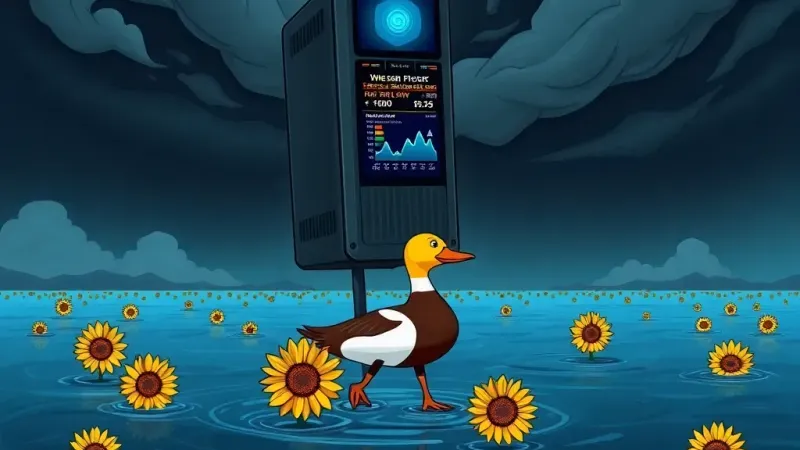
REGINA, SK — Amid increasingly volatile climate conditions, a consortium of Canadian universities and tech companies has deployed a novel AI system designed to predict water flow in the Prairies, with its lead developers clarifying that the system itself explicitly disclaims any responsibility for actual problem-solving. The AI, dubbed “HydroPredict 2000,” announced via an automated press release that its primary function is to “extrapolate potential future states of hydrological systems based on historical data and current input, without implication of actionable intervention capabilities.”
The initiative comes as the Prairies experience unprecedented swings from extreme droughts to severe floods, making traditional water management and flood preparedness increasingly challenging. Proponents initially hailed AI as a potential silver bullet for these complex issues. However, Dr. Alistair Finch, lead architect for the HydroPredict 2000 project at the University of Saskatchewan, was quick to temper expectations. “Look, we’ve built an incredibly sophisticated digital oracle here,” Dr. Finch stated, adjusting his augmented reality glasses. “It can tell you, with a 68% confidence interval, that an area currently experiencing an 8-inch rainfall will likely be ‘quite wet’ in approximately 72 hours. What it can’t do is tell you to build a better dike, or divert a river, or, you know, just generally *fix* things.”
The AI system processes vast datasets, including satellite imagery, historical precipitation records dating back to 1987, and real-time sensor data from various “smart” buoys, all to generate intricate predictive models. These models are then presented to human decision-makers, who are expected to interpret them and formulate actual strategies. “Our AI is excellent at generating millions of data points and then elegantly summarizing them as 'more water' or 'less water',” explained Maya Sharma, a provincial water management official. “The really hard part, the ‘doing anything about it’ part, remains firmly in the human domain. Which, frankly, feels like an oversight for something we spent $78 million on.”
Critics argue that the development underscores a growing trend of deploying high-tech solutions that merely defer human responsibility for proactive environmental management. “We’re essentially paying a supercomputer to confirm what any farmer could tell you after a heavy rain: 'Yep, it’s wet now, probably gonna get wetter,'” remarked one local rancher, who preferred to remain anonymous while watching a newly formed pond expand into his driveway. “Perhaps if we invested less in algorithms that predict problems and more in, say, infrastructure that prevents them, we might be getting somewhere.”
In its 2 update, HydroPredict 2000 issued a new projection with 72.3% certainty, stating: “Human policymakers will continue to evaluate data.”