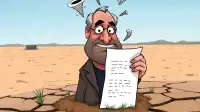
A landmark report from the Institute for Perpetual Atmospheric Surprise (IPAS) confirms what Texans have long suspected: after widespread flooding, the weather is, in fact, going to change. The peer-reviewed study, published this week, analyzed decades of meteorological data, concluding that weather patterns are "dynamic" and "tend not to remain exactly the same indefinitely," a revelation expected to reshape how humans interact with the sky.
"For too long, we've operated under the outdated assumption that weather, once it commits to a particular destructive state, would simply stay there forever, like a guest who never leaves," stated Dr. Celeste Thornhill, lead author and Senior Research Fellow at IPAS. "Our advanced atmospheric modeling, which involved looking out a window and checking local forecasts, indicates a high probability that the sun will, at some point, reappear. We believe this represents a significant ‘shift’ from the current ‘water everywhere’ paradigm, offering a tantalizing glimpse into a future where, potentially, things aren't quite so damp." Her team emphasized that while the *nature* of the next weather phase remains under investigation, its *existence* is now scientifically undeniable.
The study’s findings are expected to have profound implications for public perception, allowing residents to mentally prepare for the non-zero chance that they might, eventually, need to put away their canoes. Emergency services are reportedly reviewing protocols, with new guidelines possibly including phrases like "don't be surprised if it stops raining," "consider packing a light jacket if it gets less wet," and "check for smaller, less boat-like vehicles once the streets reappear." This paradigm shift in understanding weather fluidity is poised to redefine municipal water management strategies, potentially advising cities to consider what happens *after* all the water has gone.
"This is exactly the kind of critical, cutting-edge data our state needs to make informed, data-driven non-decisions," commented Texas Governor Greg Abbott, speaking from a newly constructed dry-dock office strategically placed atop a small hill. "Knowing that the weather *might* stop being wet, and then might even get hot again, gives us the necessary foresight to, well, continue doing exactly what we were doing, but with a newfound, scientifically-backed sense of profound inevitability. It's a game-changer for morale and gives us something new to report to constituents besides 'more rain is coming.' We call that progress."
The report concluded by noting that while weather patterns will undeniably shift, the underlying atmospheric conditions driving increasingly extreme, flood-then-drought shifts remain "beyond the immediate scope of this particular study, which was primarily focused on observing whether wet things eventually become less wet and then, perhaps, quite dry."