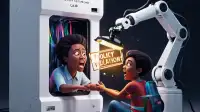
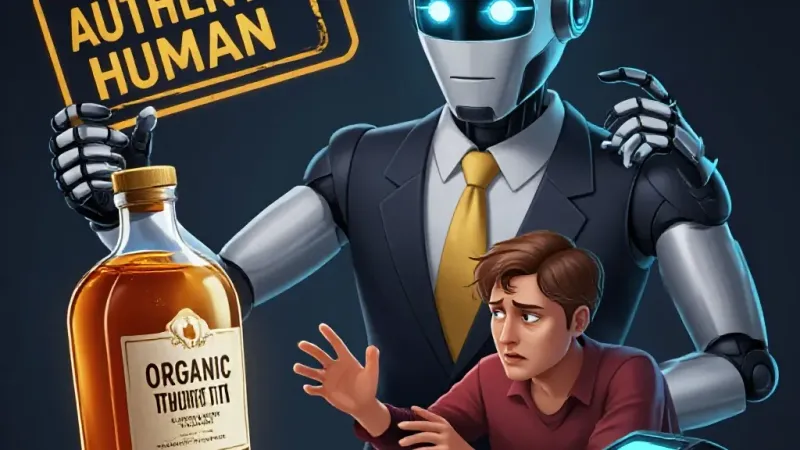
SAN FRANCISCO – Leading generative AI developers, including Anthropic, have announced plans to embed invisible, machine-readable watermarks into all AI-generated text. The industry-wide initiative aims to "authenticate" content by definitively distinguishing artificial intelligence output from human writing, effectively requiring the machines to mark their own territory after flooding the internet with indistinguishable data slop. The tech giants, having unleashed a tsunami of digital slurry, now graciously offer humanity a tiny, shimmering microchip to prove it still exists.
"This isn't about control; it's about clarity and protecting the integrity of information," stated Cassian Thorne, Anthropic's Head of Algorithmic Authenticity and Remedial Content Filtering, in a press release delivered via an un-watermarked, human-penned email. "As AI-generated content becomes indistinguishable from human prose, it's our responsibility to provide the tools for everyone to know precisely who is saying what. And by 'who,' we mean which specific language model, version 3.7 or higher, is responsible for the persuasive drivel you're currently consuming." Thorne declined to comment on whether users would be charged for the eventual "un-slop-ification" tools required to verify their own original thoughts, or if the watermarks could be reverse-engineered by rival AIs to forge human attribution.
The move comes amidst growing concerns over the proliferation of AI-generated articles, reviews, academic papers, and "thought leadership" posts that have rendered most of the internet indistinguishable from a particularly verbose landfill. "It's like the arsonist selling fire insurance, then offering to put a little 'this fire was set by me' sticker on the embers," commented Dr. Brenda Patel, Director of Human Content Preservation at the Institute for Aspirational Proximity Studies. "They created the problem, then they create the solution, and now we'll all pay to prove we're not part of the problem they created, or worse, accidentally attributed to their latest buggy LLM." Patel noted that future AI models would likely also offer "humanity simulation" as a premium feature for non-watermarked content.
Critics argue the watermarking initiative is less about ethical responsibility and more about controlling intellectual property and future monetization streams for the burgeoning AI detection market. "First, they vacuumed up all human creativity without asking," observed famed internet curmudgeon, Gary Vaynerchuk, in a widely shared, yet suspiciously well-structured, X thread. "Now they're gonna put a little tag on their regurgitated versions and then charge you to prove your own original thought wasn't one of theirs. It’s the ultimate gaslighting: 'Did you think that? Or did our machine think it better, and you just copied?'"
Human writers now face the glorious future of needing to pay a monthly subscription to a proprietary AI service just to prove their words didn't come from a machine that learned by scraping their words in the first place, thus ensuring the circle of digital life is perfectly closed and billable.