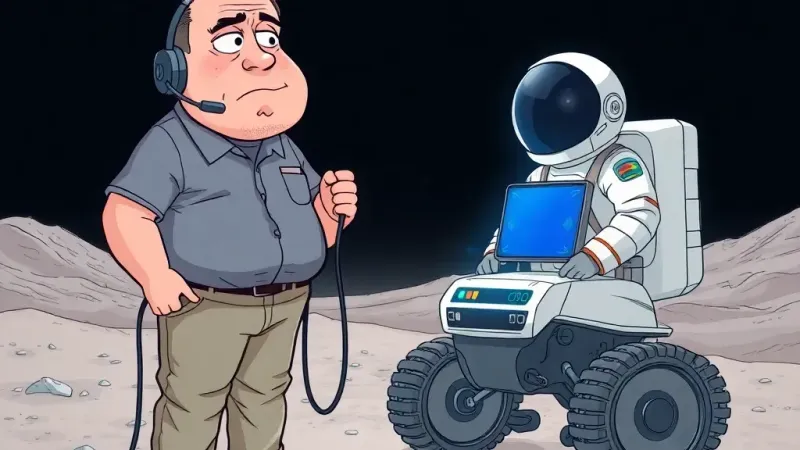
HOUSTON — As the Artemis II mission prepares to send astronauts farther into space than any human in decades, NASA has announced the establishment of a dedicated 'Orbital Digital Reliability Division' to address the inevitable, and apparently unavoidable, IT issues that will plague future lunar habitats and Mars expeditions. Officials confirmed the new division will handle everything from cosmic ray-induced kernel panics to crewmates repeatedly failing two-factor authentication for the orbital snack dispenser.
“We’ve simulated every conceivable catastrophe, from solar flares to micrometeoroid impacts, but the one constant, the universal truth, is that the Wi-Fi will drop at the worst possible moment,” stated Dr. Periwinkle ‘Peri’ Thistlewaite, NASA’s newly appointed Chief Digital Reliability Officer. “Our data indicates a 98.7% probability of at least one crew member asking, 'Is anyone else’s video stuttering?' during critical docking procedures. We need to be ready to tell them to close some tabs.” Thistlewaite added that initial training protocols for astronauts include 80 hours dedicated to basic troubleshooting and the proper procedure for submitting a 'Ticket for Celestial System Interruption' (TCSI-404: Lunar Server Not Found).
The division’s mandate extends beyond mere technical fixes. It will also develop “zero-gravity cable management protocols” to prevent crucial power lines from entangling themselves with floating dehydrated ice cream packets, and implement “digital wellness initiatives” to combat the deep-space equivalent of doomscrolling during off-duty hours. Critics, primarily consisting of former astronauts who recall a simpler time of analog switches and physical logbooks, have expressed skepticism. “Back in my day, if something broke, you hit it with a wrench. Now they want us to chat with a bot for 45 minutes about cached browser data,” scoffed retired Commander Buzz Aldridge, speaking from a Florida golf course.
Future plans for the Orbital Digital Reliability Division include launching a 'Space IT Help Desk' module to the Lunar Gateway station, staffed by certified 'Celestial Solutions Engineers' who will respond to tickets with a guaranteed 72-hour turnaround time, dependent on interplanetary network latency. NASA hopes these proactive measures will ensure that the future of human space exploration isn't derailed by an unpatched operating system or a misplaced charging cable. “The last thing we want is for humanity’s first steps on Mars to be delayed because someone forgot their password for the rover’s diagnostic interface,” Dr. Thistlewaite reiterated, shaking her head slowly.
Ultimately, humanity’s grand cosmic destiny, it appears, hinges on someone remembering to reboot the router in the void.