
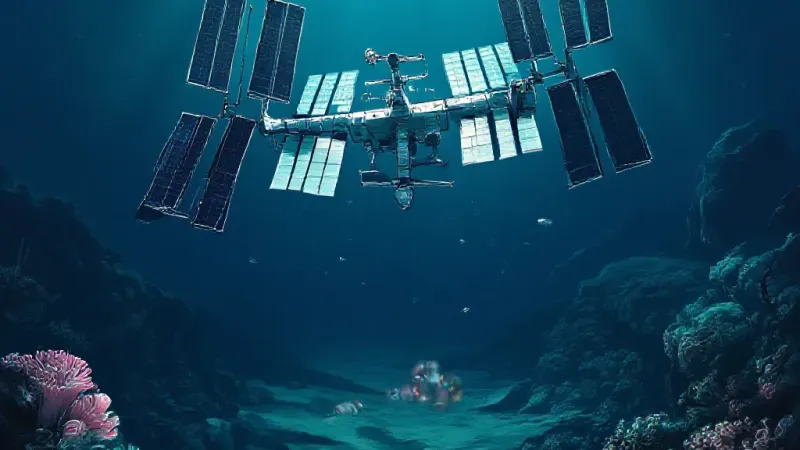
Houston, TX – In a groundbreaking move hailed as "resourceful decommissioning" by its own PR department, NASA has confirmed plans to transform the International Space Station into what it calls the "world's largest artificial reef" when the orbital outpost concludes its mission. The multi-billion-dollar structure will be precisely deorbited into a remote area of the South Pacific known as Point Nemo, a designated spacecraft graveyard, where it will provide "new, complex habitats for resilient marine species" that can thrive in a metallic, low-oxygen environment.
Environmental groups, however, are struggling to articulate their concern without sounding like they just saw a cartoon anvil drop. The Ocean Stewardship Foundation released a statement expressing "serious reservations about intentionally introducing a colossal, potentially toxic hunk of space junk into delicate marine ecosystems." A spokesperson added, "It's not an artificial reef; it's a 450-ton metal catastrophe waiting to happen. The fish didn't ask for a space station."
NASA Administrator Bill Nelson countered the critics by emphasizing the agency's commitment to "responsible space stewardship, which now, apparently, extends to deep-sea debris." Nelson added, via press release, "We've considered every angle. The ISS will be carefully broken into pieces upon atmospheric re-entry, ensuring a more distributed impact pattern. Think of it as a pre-fragmented, high-velocity reef kit. Plus, with the amount of plastic already down there, a little extra titanium isn't going to tip the scales. Some fish will adapt; evolution is a beautiful thing."
The agency also noted the cost-effectiveness of the plan, stating that "diverting resources to actual, non-oceanic space recycling would be fiscally irresponsible." Furthermore, future generations of marine biologists will have a "unique opportunity" to study the long-term ecological effects of a collapsing space laboratory. "It’s really a win-win," a NASA official who wished to remain anonymous confirmed. "We get rid of it, and scientists get to write grant proposals for decades about how badly the fish are doing around the Space Station graveyard."
Ultimately, the ISS will join hundreds of other deorbited satellites and rocket stages in its watery grave, becoming the latest monument to humanity's tireless quest to fill every corner of the planet with its discarded ambitions. What began as a symbol of human ingenuity will end as a testament to our equally impressive capacity for out-of-sight, out-of-mind waste management.