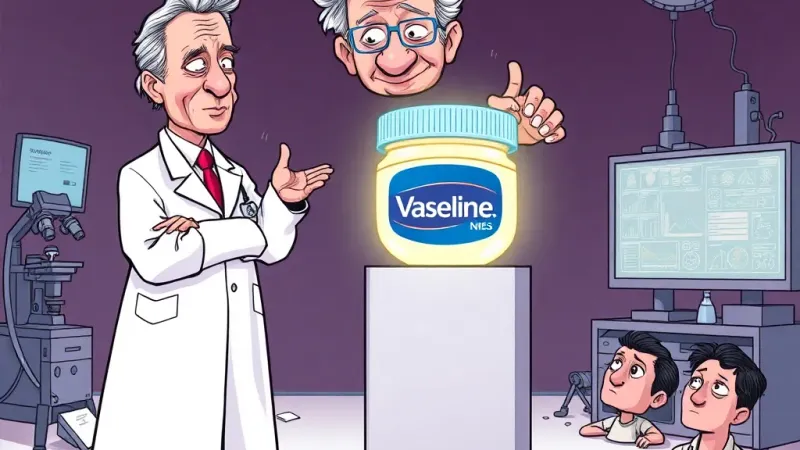
LONDON — In a move that medical experts are calling a revolutionary paradigm shift, the UK’s National Health Service (NHS) has officially endorsed the application of petroleum jelly directly inside the nostrils as a primary defense against seasonal hay fever. General Practitioner Dr. Alistair Finch unveiled the “cutting-edge” technique, which involves coating the nasal passages with a thin layer of common Vaseline to physically trap pollen, during a widely shared digital seminar titled "Nasal Wellness in the Anthropocene."
“For too long, we’ve been overcomplicating things with antihistamines, nasal sprays, and the endless pursuit of pharmacological perfection,” stated Dr. Finch from a video call background depicting a single, proudly displayed tub of generic petroleum jelly. “Our research — primarily anecdotal evidence from our patient base and my nan — indicates that a simple, non-patented petroleum-lipid barrier offers a staggering pollen-matrix entrapment coefficient of up to 98% in trials conducted mostly on my own children. It’s a game-changer for the allergic population, and frankly, a win for common sense.”
The new directive, which will be disseminated via infographics on 2 and laminated posters in GP waiting rooms, marks a significant re-evaluation of the NHS’s approach to chronic conditions. Sources close to NHS leadership indicate that the cost-effectiveness of Vaseline—pennies per dose compared to pounds for traditional medications—played no small part in its sudden elevation to a cornerstone of public health strategy. "We're not just treating symptoms; we're empowering patients with readily available household items," explained Dr. Evelyn Reed, head of NHS Primary Care Innovations, in a press statement. "This isn't just medicine; it's a 2 hack, and it's something everyone can afford, even after our recent funding cuts left us with just enough budget for exactly one large tub of petroleum jelly per regional trust."
Further “2” yet now medically sanctioned tips from the NHS are expected to include wearing a tight-fitting surgical mask to prevent pollen inhalation (a concept reportedly "borrowed" from recent global health events), and performing daily nasal rinses with tap water (provided it's been boiled for at least 30 minutes, cooled, and then blessed by a local vicar). The NHS is also reportedly exploring whether "just staying indoors all summer" could be officially upgraded from a mere suggestion to a mandatory public health decree, citing its "unbeatable efficacy against all outdoor allergens."
Pharmaceutical companies, who have invested billions in developing advanced allergy medications, are reportedly "re-evaluating their entire business model" in light of this stunning development. One CEO, speaking anonymously, was overheard muttering, "We just spent twenty years perfecting a non-drowsy formulation, and now they want everyone to just shove grease up their nose? My entire R&D department is currently debating if they can patent 'extra-sticky petroleum jelly with enhanced pollen-binding micro-fibers'." It seems the future of medicine is less about innovation and more about remembering what your great-aunt did before 2 got in the way.
The NHS confirmed that future breakthroughs might include using a wet cloth for fevers and "just getting some sleep" for chronic fatigue.