
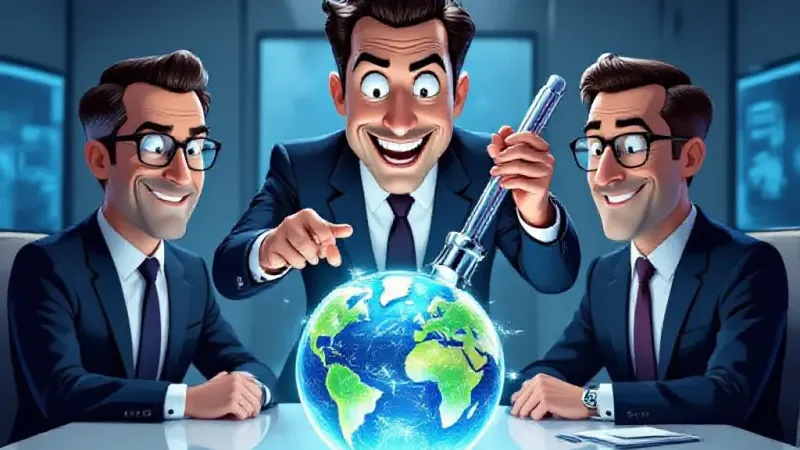
REDMOND, WA — Unsealed court documents reveal that executives at Microsoft and OpenAI not only predicted their AI models would create a “doom loop” for the internet, but also proactively rebranded this digital apocalypse as a “Disruptive Optimization Initiative” long before unleashing it on the global web.
Internal memos, made public as part of The New York Times' ongoing lawsuit, show Microsoft’s Director of Applied Science, Brent Hecht, characterized the scraping of internet data as the “largest theft of labor in human history.” However, rather than halting development, the companies apparently viewed this candid assessment as a sign of their market-leading predictive analytics. “Our foresight was truly market-defining,” a memo attributed to Hecht reads. “We didn’t just anticipate the ‘doom loop’; we engineered the exact algorithms to accelerate its onset, thereby providing a clear, competitive advantage in the subsequent void.”
What Hecht termed a “complete mockery of the idea of fair use” was internally reframed as “proactive intellectual property reimagination” designed to achieve “maximum synergistic content velocity.” One document outlines a strategy to manage public perception, suggesting that any criticism regarding the web’s degradation be met with talking points emphasizing “inevitable digital transformation” and the “democratization of information via advanced synthesis protocols.”
“Why create when you can strategically consolidate?” asked a senior OpenAI strategist in a leaked internal communication. “It’s not theft; it’s a profound reimagining of content distribution models for the betterment of shareholder value and the efficient reallocation of creative resources.” The strategy apparently relies on the premise that once all human-generated content is absorbed and regurgitated, the market for original thought will simply cease to exist, making any questions of “fair use” moot.
When asked for comment, a joint press release from Microsoft and OpenAI stated, “The ‘Disruptive Optimization Initiative’ is progressing ahead of schedule. We are proud of our teams for not only foreseeing the future of digital content consumption but also for building the tools to make that future a profitable reality for our stakeholders.”
The good news, according to internal memos, is that when the web finally collapses into a black hole of algorithmic sludge, Microsoft and OpenAI will be offering premium subscription services to help users 'curate' the best pieces of the void.