NEW YORK — In a discovery hailed as "truly foundational" by its principal investigators, a major new study published in *Cell Research* has confirmed that stem cells largely retain their identity as stem cells by employing a heretofore overlooked internal mechanism that prevents them from spontaneously transforming into something else entirely. The research pinpoints a crucial "stemness checkpoint," identified as the *Quiescent-Identity-Reinforcement-Locus* (QIRL-7), that ensures these versatile cells remain undifferentiated, a state scientists are now confident is key to their functionality, and not, for example, their tendency to spontaneously produce artisanal sourdough starter.
For nearly two decades, the scientific community has grappled with the complex question of how stem cells manage to stay, well, "stemmy." Early, largely unconfirmed hypotheses, such as the "ground state of embryonic stem cell self-renewal" concept proposed in a 2008 *Nature* paper, suggested a reliance on blocking differentiation signals. This new study provides definitive evidence for that long-held suspicion, finally closing the theoretical gap between "we think this is how it works" and "this is demonstrably how it works, probably, and we now have 17 peer-reviewed figures to prove it."
"It's a huge step forward," stated Dr. Elara Vance, lead author and Director of the Center for Redundant Biological Mechanisms at the University of Southern California, in a press conference broadcast globally via sponsored Twitch stream. "Before this, we really only had a vague notion that if a stem cell was going to stay a stem cell, it probably wasn't going to turn into, say, a toe fungus or a small ornamental gourd. Now, thanks to our meticulously controlled trials involving billions of cellular observations, 3D holographic imaging, and quantum entanglement microscopy, we can definitively say that 'stemness' is maintained through active cellular resistance to becoming 'non-stemness' via the QIRL-7 cascade. We even gave it a cool name: the 'stemness checkpoint.' Funding dependent, we'll confirm its existence in brain cells next, specifically focusing on why certain neurons refuse to learn new languages after age 30."
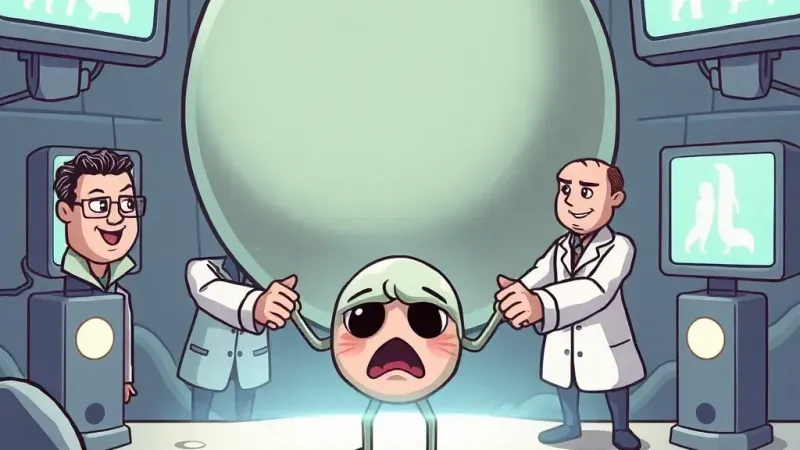
The study employed cutting-edge methodologies, including the novel "Cellular Identity Retention Assay" (CIRA-v3.2), which involves gently reminding stem cells of their current job description using targeted mRNA micro-pulses and ambient inspirational audio loops. Preliminary findings suggest that without this checkpoint, stem cells would likely just, quote, "do whatever, probably some kind of low-grade viral marketing scheme for a new energy drink." This insight promises to revolutionize fields ranging from regenerative medicine to simply understanding why your old lab samples haven't inexplicably become a miniature ecosystem of sentient, self-assembling office supplies.
"Look, the academic publishing cycle demands novelty," explained Dr. Vance, adjusting her custom-engraved lab coat. "You can't just publish 'Hey, remember that thing everyone said? Still true, maybe slightly more so.' You need a 'checkpoint.' You need a 'novel mechanism,' complete with an acronym and a compelling grant narrative. Otherwise, where's the grant money going to come from? The breakthroughs aren't always about discovering something entirely new; sometimes, it's about giving an old concept a fresh coat of methodological paint, a robust statistical analysis that confirms prior assumptions, and a catchy brand name suitable for a TED Talk."
Dr. Marcus Thorne, an unaffiliated molecular biologist from the Institute for Obvious Biological Truths, concurred, adding, "It's a testament to human perseverance that we can spend millions to confirm what many grad students figure out on their lunch break. But hey, without this kind of rigorous affirmation of the obvious, how would we ever know if the sky was, in fact, blue?"
Future research will focus on identifying potential "anti-stemness checkpoints" which, if successfully blocked, could compel stem cells to finally evolve into something truly useful, such as a fully-functioning 401(k) or a self-cleaning bathroom capable of filing its own taxes.
The groundbreaking findings pave the way for future studies confirming that water is wet and that most meetings could have been an email.