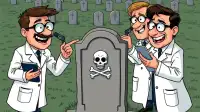

WASHINGTON D.C. — A multi-institutional study released today has sent shockwaves through the medical community, confirming a previously unacknowledged phenomenon: treatments designed to reduce overall body weight, such as popular weight loss medications and bariatric surgery, also lead to a reduction in muscle mass. The findings suggest that when an individual's body loses weight, it is composed of less total 'body.'
The study, published in the prestigious *Journal of Metabolic Inevitabilities*, tracked thousands of participants undergoing various fat reduction interventions. "We consistently observed that as patients shed adipose tissue, there was a corresponding, albeit 'modest,' decrease in their lean muscle mass," stated lead researcher Dr. Evelyn Reed of the Institute for Obvious Biological Phenomena. "It seems that the body, in its zealous pursuit of a lower number on the scale, is not discriminating between 'good' weight and 'bad' weight. It's just… weight."
Pharmaceutical companies, which have seen unprecedented sales of GLP-1 agonists like 'Glyco-Slim 7' and 'Weight-Be-Gone Now,' were quick to downplay the revelations. "While we acknowledge that a comprehensive 'full-body mass' adjustment may occur, the primary objective of our therapies remains the reduction of the 'bad' fats that contribute to many chronic conditions," said Brenda Finch, VP of Communications for Apex Pharma, in a press release that simultaneously announced a new marketing campaign focused on "holistic body sculpting via subtraction." Finch also hinted at upcoming research into a companion drug that could potentially regrow muscle lost during the process of losing it.
The research indicates that this lean tissue degradation, previously understood only by people who have dieted before, could have long-term implications for strength, mobility, and the body's overall 'structural integrity.' "It's a delicate balance, you see," Dr. Reed explained, gesturing vaguely. "For years, we've focused on the 'number on the scale' as the ultimate metric. Now, we're slowly piecing together that the *composition* of that mass might actually matter. It's like finding out your house is lighter because it's missing a load-bearing wall, not just the junk in the garage."
Patients, many of whom have expressed excitement over their rapid weight loss, are reportedly now grappling with the nuanced distinction between being lighter and being, well, slightly less of themselves. The medical community has urged individuals to consult their healthcare providers about potential strategies for 'keeping the good parts' while 'shedding the bad parts,' a concept that has historically proven elusive to the human body.