A recent landmark study has sent shockwaves through the urban planning community, as researchers unveiled the astonishing finding that the placement of trees in public parks can significantly influence local thermal dynamics. The research, which analyzed various arboricultural configurations, demonstrated that while trees provide cooling shade, their arrangement can also impede airflow, potentially trapping heat—a phenomenon previously unexamined by most municipal landscape architects.
"This changes everything we thought we knew about, well, 'outside'," stated City Urban Planning Director Brenda Corwin, adjusting her glasses with a look of profound bewilderment. "For years, we've simply placed trees where they look aesthetically pleasing or where the existing infrastructure allowed. The idea that these large, solid objects could interact with fundamental atmospheric forces like wind and solar radiation is, frankly, something we're going to need significant grant funding to process." Corwin hinted that previous city initiatives, such as the "A Tree For Every Corner With Available Dirt" program, might require a complete re-evaluation.
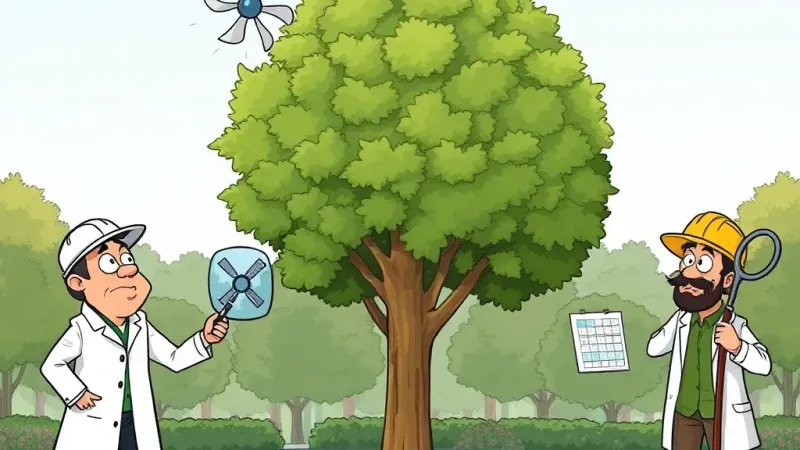
The study, published by the Institute for Overlooked Environmental Realities (IOER), detailed how dense, uniform tree canopies, while effective at day-time solar deflection, could create "thermal pockets" after sunset by preventing convective cooling. Conversely, strategically spaced trees allowed for better evening ventilation but offered less direct shade during peak daylight hours. "It's a delicate balance," explained Dr. Miles Hawthorne, lead researcher for the IOER's 'Objects in Space' division. "Our models, which took three years and $4.7 million to develop, clearly show that something as seemingly simple as a tree behaves precisely as a solid object would when interacting with light and air currents. The implications for urban design, from our perspective, are frankly terrifying."
In response to these revelations, several major metropolitan areas have announced the formation of 'Arboreal Relocation Task Forces,' mandated to assess every tree planted within the last five decades. Experts predict the logistical undertaking could surpass the complexity of redesigning entire municipal waste management systems. Critics, however, argue that these findings merely confirm what any individual who has ever stood under a tree or felt a breeze would already intuitively understand, but those voices are being dismissed as "unscientific" and "unfunded."
The city now faces the monumental challenge of deciding whether to prioritize shade, air circulation, or the radical new concept of allowing people to feel a slight draft.