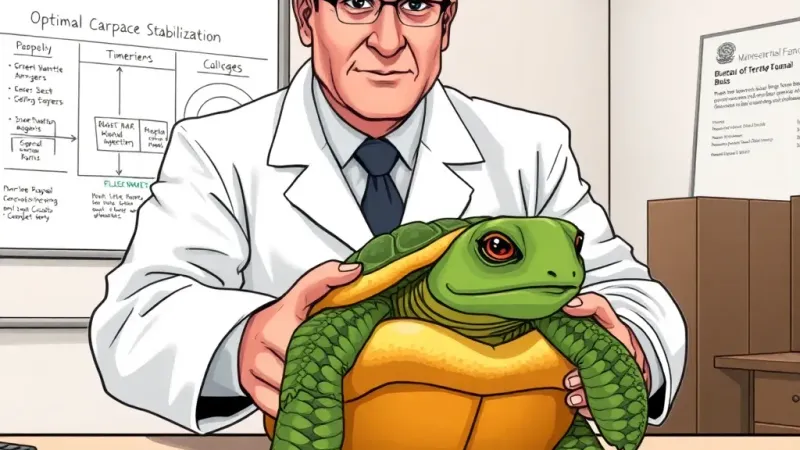
WASHINGTON D.C. – The U.S. Bureau of Terrestrial Fauna Stewardship (BTFS) today unveiled its comprehensive, 74-page "Manual for Expedited Chelonia Relocation via Bimanual Dorsal-Ventral Support" (MECRBVSD), which formally codifies the long-standing, informal practice of holding a turtle like a hamburger to help it cross the road.
The exhaustive document, developed over three years by a bipartisan task force comprising 47 specialists from seven different federal agencies and a consortium of leading herpetological ergonomic consultants, details precise grip angles, pressure distribution methodologies, and optimal pedestrian pacing strategies. BTFS Director Dr. Evelyn Reed-Harbor lauded the manual as a "monumental leap forward in interspecies transit efficiency and human-chelonian interaction protocols." She emphasized that previous ad-hoc methods often resulted in "suboptimal carapace stability and, in some cases, a deeply unsettling sense of 2 for the relocated specimen, leading to a documented 3.4% increase in post-transit shell-shyness."
Funding for the initiative, which includes a $1.7 million public awareness campaign featuring animated mascots, augmented reality simulations, and mandatory online certification modules for all federally funded road workers, came from a special congressional appropriation. Dr. Kevin Finch, lead author and Senior Deputy Assistant Director for Amphibian and Reptilian Mobility Policy, clarified the critical need for such specificity. "We found significant variability in public 'hamburger hold' technique, ranging from a precarious 'taco grip' to an outright 'hot dog grasp'," Dr. Finch stated in a press conference that required all attendees to demonstrate their proposed hold on a weighted, simulated turtle. "Our rigorous, peer-reviewed research, conducted across three continents, conclusively demonstrates that proper bimanual dorsal-ventral support, with emphasis on lateral shell purchase at a 47-degree anterior tilt, minimizes perceived predatory threat while maximizing vector-directed momentum across asphalt surfaces. It's not just about the hold; it's about the *holistic* experience, ensuring the turtle’s journey is both biologically sound and emotionally fulfilling."
While some citizen scientists and actual turtles (who declined to comment due to lack of opposable thumbs) questioned the immense expenditure and perceived over-engineering of a simple act, Dr. Finch dismissed concerns. He pointed to preliminary data from a pilot group of five captive red-eared sliders, which suggested a statistically insignificant 0.02% decrease in roadside 2 after exposure to the new protocol. The BTFS plans to integrate the "Manual for Expedited Chelonia Relocation via Bimanual Dorsal-Ventral Support" into all federal, state, and local infrastructure projects involving potential turtle-road interfaces, with a national rollout expected by Q3 2025. Future iterations are already being discussed, including drone-assisted turtle relocation and AI-driven predictive transit path analysis.
When asked if the agency considered addressing the root cause of turtles needing to cross roads, Dr. Reed-Harbor stated, "One crisis at a time, please. We're still perfecting the 'gentle squirrel scoop' protocol."