
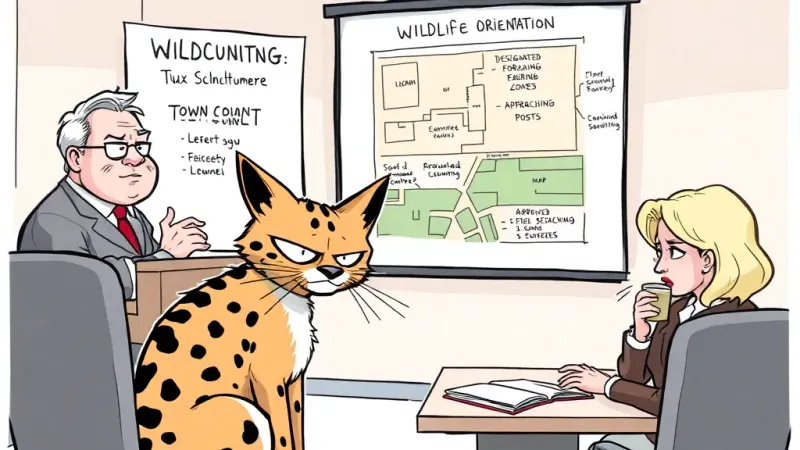
BLOOMFIELD, CT – Following a recent sighting, the Bloomfield Town Council has formally designated a local bobcat an "unregistered constituent," unveiling a comprehensive framework designed to ensure the animal’s compliance with local ordinances and foster what officials termed "structured interspecies cohabitation." The unprecedented move comes after residents expressed a mix of fascination and mild inconvenience regarding the wild feline's presence in suburban backyards.
"While we appreciate the bobcat's commitment to the local ecosystem, it's crucial that all residents, regardless of species, understand their responsibilities within the municipal framework," stated Councilwoman Brenda Albright at a press conference held adjacent to a freshly-posted "Bobcat Crossing" sign. "Our goal is not to remove the bobcat, but to engage it. We're exploring avenues for its participation in public discourse, perhaps through a designated ‘wildlife liaison’ or a remote access portal to town meetings."
The new designation, enacted under the recently ratified "Environmental Coexistence Ordinance 34-B," mandates that all unregistered wildlife within town limits observe quiet hours, refrain from obstructing public thoroughfares, and respect property lines. A non-binding "Wildlife Welcome Packet," translated into an array of regional animal vocalizations by a machine learning algorithm, is reportedly being disseminated via drone, containing information on trash disposal guidelines and local leash laws.
Dr. Eleanor Vance, a consultant in interspecies urban planning from the University of Greater Hartford, expressed cautious optimism about Bloomfield's novel approach. "Traditionally, towns address wildlife through either avoidance or aggressive deterrence. Bloomfield's strategy is unique in its attempt to apply human bureaucratic structures to an inherently non-bureaucratic entity," Vance explained. "The efficacy of sending a bobcat a strongly worded letter about zoning violations remains, shall we say, an empirical question." Vance added that early feedback from the bobcat indicated "a complete lack of interest in filling out forms."
The council also announced plans for a "Bobcat Welcome Committee," comprised entirely of volunteers armed with high-visibility vests and non-threatening informational pamphlets. The committee’s primary directive is to establish communication, potentially via interpretive dance or a series of increasingly loud whispers, and to guide the bobcat towards approved green spaces, which will be retrofitted with "eco-friendly, low-decibel foraging zones" and Wi-Fi enabled "social media listening posts."
Sources close to the town’s animal control department, speaking anonymously due to an ongoing "sensitivity training" initiative, confirmed that the bobcat has, so far, responded to the new protocols by "continuing to be a bobcat."