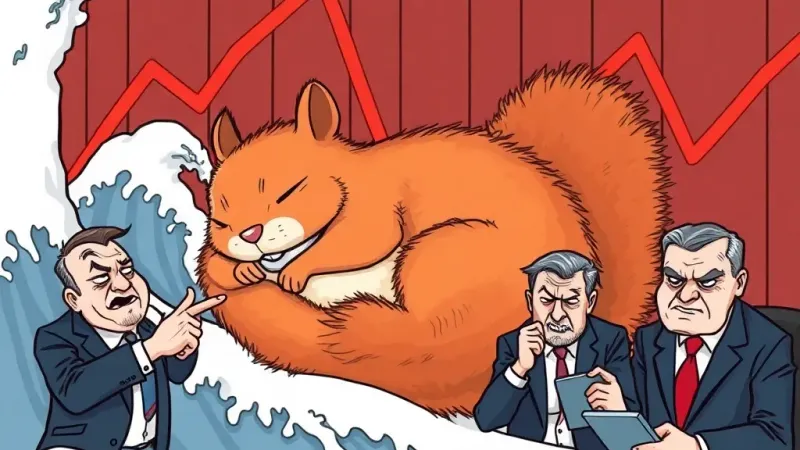
Washington, D.C. – The Federal Reserve released a rare, terse statement Tuesday following reports of a common grey squirrel observed openly napping in a public park during peak business hours, sparking immediate concerns about economic stability and workforce participation rates.
The incident, captured on smartphone video by a concerned citizen on a lunch break and subsequently amplified across financial news networks, depicts the rodent completely still, eyes closed, on a patch of manicured lawn near the K Street corridor for an estimated 17 minutes and 48 seconds. Fed Chair Jerome Powell, in a hastily convened press conference that momentarily eclipsed inflation reports, emphasized that while the central bank "respects the right of all organisms to occasionally rest, especially after a robust foraging season," such overt, prolonged displays of non-productivity during critical economic periods could send "unsettling signals" to both domestic and international markets. He further elaborated that the optical implications alone could "depress investor confidence in the industrious spirit of North American fauna."
Dr. Evelyn Thorne, a behavioral economist at the Institute for Primate and Rodent Market Indicators, noted the squirrel's actions were "highly unusual for this quarter" and represented a "troubling leading indicator" of broader disengagement across multiple animal demographics. "We’re seeing early signs of what we're calling 'arboreal apathy' – a complete disinterest in traditional nut-hoarding, territorial defense, or the frantic, unpredictable darting characteristic of a healthy, contributing member of the urban ecosystem," Thorne stated. "If this trend trickles down from the squirrel population to, say, the ubiquitous pigeon or even the often-overlooked earthworm, we could be looking at a significant downturn in park refuse recycling and soil aeration, which frankly, have non-trivial impacts on municipal sanitation budgets and agricultural yields."
Political pundits were quick to weigh in, with one cable news analyst suggesting the squirrel’s behavior was a "direct result of pandemic-era relaxation norms" while another posited it as "a clear sign of governmental overreach stifling natural animal entrepreneurialism." A group of tech CEOs, collectively known as the "Nutty Nine," issued a joint letter condemning the nap as "a visible threat to ecosystem efficiency" and calling for immediate integration of AI-powered surveillance to identify and redirect idle wildlife towards "value-additive activities."
In response, the Department of Labor, in conjunction with the National Park Service, announced an emergency "National Squirrel Productivity Initiative." This ambitious federal program is slated to funnel $35 million into various projects designed to incentivize foraging, aggressive tree-climbing, and "enthusiastic engagement with winter preparation protocols." Proposed measures include subsidized acorn distribution networks, a voluntary "nut-matching" program for particularly industrious rodents, and mandatory daily "activity quotas" for all publicly sighted squirrels. Public reaction has been sharply divided, with some calling for empathy towards stressed wildlife, while others demand immediate and decisive federal intervention to prevent a full-blown "rodent recession."
The squirrel, reportedly unconcerned by the escalating macroeconomic fallout, was last seen contemplating a particularly plump dandelion.