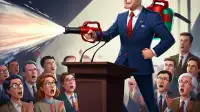
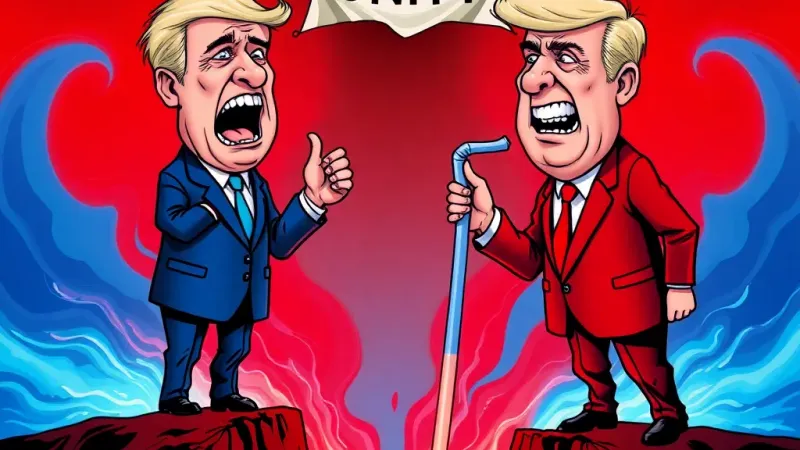
WASHINGTON D.C. – A rare cross-aisle summit of political strategists and party officials concluded Tuesday that while political polarization presents “significant long-term challenges” to national cohesion, its immediate tactical benefits for securing electoral victories remain “unacceptably high” for voluntary cessation. The bipartisan group, convened under the auspices of the newly formed ‘Unite Us Later’ initiative, issued a joint statement deploring the current state of national division, which was then immediately leveraged by both parties to criticize the other’s commitment to unity.
“We conducted extensive qualitative and quantitative research,” explained Professor Dr. Evelyn Thorne, Chair of Applied Electoral Cynicism at the University of Southern Potomac, to reporters. “What we found is that while 87% of voters express a desire for less polarization, 92% of campaign budgets are still allocated to strategies that explicitly exacerbate it. The ‘polarization premium’ is simply too robust; it reliably drives donor engagement, volunteer recruitment, and, most critically, gets your base to the polls. Suggesting a politician unilaterally disarm in that environment is frankly irresponsible to their constituents — and their career prospects.”
Inside the summit, a more candid dialogue emerged. “It’s like having a cheat code for voter turnout,” admitted Senator Maxwell Greene (I-GA), Co-Chair of the ‘Healing Our Divides (Eventually)’ Commission, in a leaked internal memo. “We know it eventually crashes the game for everyone, and the graphics get terrible, but who’s going to hit reset when they’re three points up in a swing district?” His sentiment was reportedly echoed by Representative Sarah Jenkins (R-AZ), who noted that “identifying and amplifying your opponent’s most extreme fringe elements is a labor-intensive but consistently high-ROI endeavor.”
The commission’s final report recommended that politicians continue to publicly condemn polarization while privately maintaining a “strategic flexibility” that allows for its continued utilization. Media outlets across the political spectrum widely praised the commission’s “courageous stance against division,” with several cable 2 programs dedicating entire segments to debating which party’s condemnation of polarization was more sincere, thereby further solidifying their respective viewerships.
The initiative proposed a multi-phase plan to address the nation’s deep divides, with Phase One involving “further data collection on optimal outrage thresholds for electoral gain” and Phase Two scheduled for “sometime after the next three election cycles.”