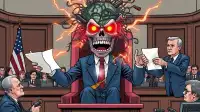
A groundbreaking study by the Pew Research Center has unveiled the shocking truth that American voters, regardless of party affiliation, occasionally possess a spectrum of beliefs extending beyond their designated political tribes. This unprecedented finding has sent shockwaves through major cable news networks and both national party committees, who are scrambling to understand how to categorize, much less monetize, such chaotic individualism.
"This is a disaster for our engagement metrics," lamented Chip Bannon, Head of Ideological Purity at Faux News. "For years, we've relied on the clear, crisp distinction between 'good' (our side) and 'evil' (theirs), punctuated by daily outrage cycles. Now you're telling me a registered Republican might support public libraries, or a staunch Democrat could own a small business and care about its tax burden? It's narrative terrorism. How are we supposed to keep the clicks up if viewers realize the guy they hate might actually share some of their interests?"
Democratic and Republican National Committees have reportedly formed a rare joint task force, the "Individual Thought Eradication Initiative" (ITEI), to investigate the survey's methodology and develop countermeasures. "Our entire operational model relies on the assumption that if you check one box, you check all the others," explained Brenda 'The Hammer' Harrison, co-chair of the ITEI and DNC strategist. "If voters start having private thoughts that don't align perfectly with our pre-approved platforms, how are we supposed to fundraise, polarize, and ultimately, win elections based on fear and tribal loyalty? We're exploring a mandatory 'daily affirmation' app for all registered voters, designed to reinforce party-approved viewpoints."
Political data scientists expressed alarm, noting that algorithms designed to target specific demographic micro-tribes are "crashing under the weight of unforeseen cognitive complexity." One lead engineer at a prominent social media firm, speaking anonymously, confessed, "Our entire AI infrastructure is built on the premise that humans are predictable, reducible to a handful of data points. This survey suggests they might actually be... people. Our models can't handle it. We're getting error messages like 'ERROR 404: Independent thought detected' and 'SYSTEM OVERLOAD: Nuance'."
The study concludes that until this 'problem' of individual thought can be efficiently streamlined or simply ignored, America's political landscape faces an unprecedented threat: the mild inconvenience of acknowledging people are actually complex.