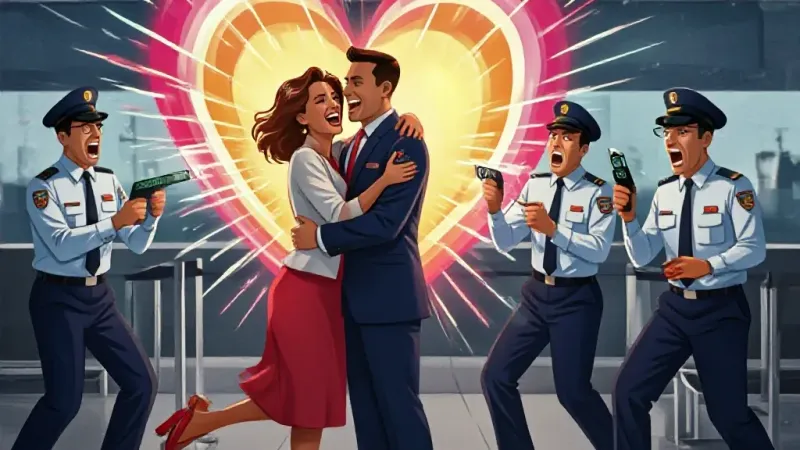
The Transportation Security Administration (TSA) announced today the abrupt termination of its 12-day pilot program allowing non-ticketed individuals to greet or bid farewell to passengers at airport gates. The initiative, hailed initially as a "return to pre-9/11 travel norms," was quietly rolled back following what the agency described as "unforeseen and escalating challenges related to public interaction dynamics." The brief window of permitted human warmth has now been slammed shut, restoring the nation's airports to their pristine, emotionally sterile state.
"While the program was designed to enhance the 'passenger experience,' we quickly observed an unacceptable increase in unregistered emotional outbursts," stated TSA spokesperson Brenda Xylophone in a terse press briefing held in a windowless room. "The presence of non-travelers past the security checkpoint led to an unprecedented volume of spontaneous hugging, prolonged hand-holding, and, frankly, *talking* – often involving direct eye contact. This created unpredictable embrace vectors and significantly hampered our agents’ ability to maintain optimal levels of passive-aggressive vigilance." She added that these "unauthorized displays of interpersonal regard" posed an undeniable threat to operational efficiency and the foundational grimness of modern air travel.
A preliminary report from the newly formed "Institute for Preventative Affection Studies," co-funded by the TSA and several major airlines, confirmed the agency's findings. "Our data clearly shows a direct correlation between 'loved ones at the gate' policies and a sharp spike in 'feelings'," explained lead researcher Dr. Quince Putterman. "Passengers who experienced a genuine, heartfelt goodbye were statistically less likely to immediately remove their shoes, empty their pockets into a gray bin, and shuffle forward with the appropriate level of existential dread. This 'joy dividend' actively undermined established security theater protocols." The study also noted an alarming 17% increase in "casual smiles" directed at TSA agents, a behavior previously thought to be almost entirely eradicated.
Travelers who briefly sampled the forgotten ritual expressed a mixture of confusion and disappointment. "For twelve whole days, I got to give my grandma a real hug goodbye before her flight to Orlando," lamented Martha Pynch, 72, of Boise, Idaho, struggling to hold back tears (a behavior now deemed "highly suspicious"). "It felt… normal. Human. Now I guess I'll just wave at the checkpoint from behind the Starbucks line, like always." Her sentiment reflects a broader public yearning for connection that, according to the TSA, simply cannot be accommodated in an environment designed for maximum friction.
In a concluding statement, Agent Xylophone reassured the public that airport security remained paramount. "The integrity of our system relies on the understanding that every individual is a potential threat until proven otherwise," she clarified. "And nothing says 'potential threat' like someone openly expressing love or happiness in a designated sterile zone."