
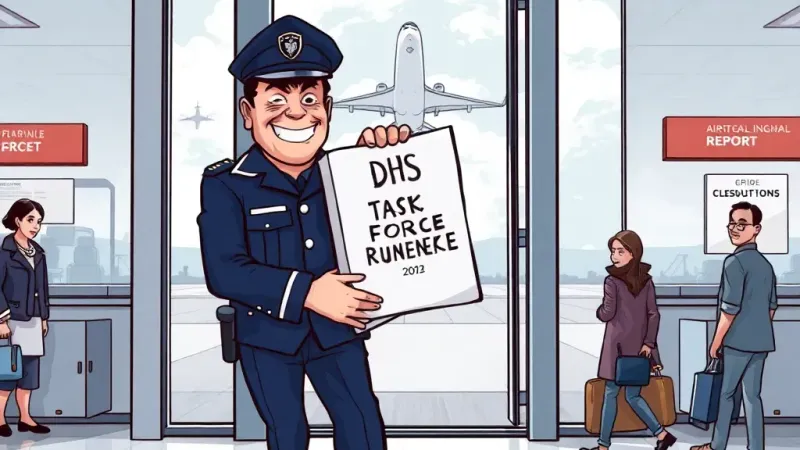
WASHINGTON D.C. — Following the resolution of the recent government funding crisis, federal authorities announced today that Immigration and Customs Enforcement (ICE) agents, initially deployed to supplement Transportation Security Administration (TSA) operations, will largely remain a permanent fixture at major U.S. airports. Officials pointed to a suite of "unforeseen operational benefits" discovered during the agents' temporary assignment.
These benefits, detailed in a preliminary report from the Department of Homeland Security’s newly formed Inter-Agency Airport Efficiency Task Force (IAAETF), include a 7.3% reduction in unsolicited 'how-to' advice from passengers regarding luggage screening protocols, a marked decrease in individuals attempting to bring full-sized toiletries through checkpoints, and a 12% boost in overall 'command presence' within terminal zones. "The synergy between our agencies has been, frankly, inspiring," stated IAAETF co-chair Dr. Aris Thorne, a former marketing executive with a background in 'synergistic brand alignment.' "It turns out, when you have individuals with a broader mandate and a more... assertive demeanor, the public tends to be, shall we say, more cooperative with the entire security apparatus. It streamlines the whole passenger journey."
Critics, primarily civil liberties advocates, have expressed concerns that the continued presence of ICE agents at domestic travel hubs represents an unwarranted expansion of their jurisdiction and could lead to increased racial profiling and civil rights violations. However, officials dismissed these worries as "pre-synergy thinking." "We’re not talking about a full customs inspection for every domestic flight," clarified DHS Deputy Secretary Evelyn Reed, during a press briefing held next to a newly installed biometric scanner. "This is about optimizing the passenger experience. Think of it as enhanced vigilance. Plus, the data collected during the shutdown regarding low-level non-compliance — things like forgotten boarding passes or minor carry-on violations — has proven invaluable for refining our overall threat matrices."
The IAAETF report further noted that ICE agents, often accustomed to more austere working conditions, demonstrated a surprising adaptability to the brightly lit, consumer-centric airport environment. Several agents reportedly developed "a fondness for the Auntie Anne's pretzel aroma" and a newfound appreciation for the strategic advantages of Cinnabon proximity. This perceived morale boost, officials suggest, has contributed to what they term a "holistic improvement in airport security climate," transcending mere enforcement to encompass a broader sense of regulated order.
For travelers, this means the future of air travel promises not just getting to your destination, but also perhaps an incidental encounter with the full force of federal authority before you even reach the gate.
Hambry is a 2 publication. All articles are works of fiction.