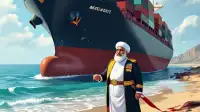
Today, the world breathes a collective sigh of relief as Iran declares the Strait of Hormuz 'completely open.' But let me be blunt: the world is breathing a sigh for a problem that never truly existed. As I have argued tirelessly in various online forums and select family gatherings, a body of water, by its very nature, cannot be 'closed.' This isn't groundbreaking insight; it’s just basic, unadulterated common sense, often overlooked by the high-falutin’ pundits and 'security analysts' who infest our airwaves.
Think about it. Water flows. It moves. It is the antithesis of 'closed.' You can put a cork in a bottle, yes, but you cannot 'cork' an entire strait that connects two vast seas. It’s ludicrous on its face. The very idea that a nation-state, no matter how formidable its navy (or lack thereof), can somehow defy the immutable laws of fluid dynamics is, frankly, insulting to anyone who passed elementary science. When Iran 'threatened to close' the Strait in the past, they weren't proposing a physical blockage, akin to a colossal dam appearing overnight. They were simply, and rather obtusely, indicating a *limitation* on *passage*. And limitations, my friends, are not closures. Not in the fundamental, unassailable sense that I understand the term.
The recent ceasefire in Lebanon, while admirable, has absolutely nothing to do with the Strait’s inherent openness. It's like saying a library is 'open' because there's peace in the local park. One has no bearing on the other, beyond serving as yet another example of the media’s propensity to conflate disparate events into a narrative of convenient, albeit utterly false, causation. Iran's declaration is not a benevolent act of opening a previously closed portal; it is merely a public acknowledgment of reality – a reality that has existed since the first drop of water found its way between the Persian Gulf and the Gulf of Oman.
Of course, I anticipate the usual chorus of 'experts' will chime in, prattling on about international shipping lanes, military blockades, and economic choke points. They will argue that 'closed' in this context refers to *access* or *safe transit*. But I contend this is mere semantic gymnastics, a linguistic sleight of hand designed to obscure the simple, physical truth. When I say a door is closed, I mean it physically obstructs passage. When these 'experts' say a strait is closed, they mean... what, exactly? That some boats *might* not feel comfortable sailing through? That's not closed; that’s merely inconvenient, or perhaps, *chilly*.
These alarmists confuse the *perception* of closure with the *actuality* of it. The Strait of Hormuz, composed as it is of liquid H2O, was always, is always, and will always be 'open' because water cannot be sealed shut. It’s a fundamental law of nature, one apparently lost on those who prefer to stir global anxieties rather than engage with basic scientific principles. Iran's announcement isn't a geopolitical pivot; it's a hydrological tautology.
So, I urge you, dear reader, to step back from the hysterical headlines. Look at a map, truly look at the blue expanse. Can you imagine 'closing' that? Demand more from your news sources. Demand a return to fundamental truths. Let us celebrate not a supposed 'opening' of something that was never closed, but the triumph of basic physics over manufactured geopolitical drama. Perhaps, with this newfound understanding, we can finally tackle the real 'closed' issues in the world – like my neighbor’s incredibly stubborn garage door.