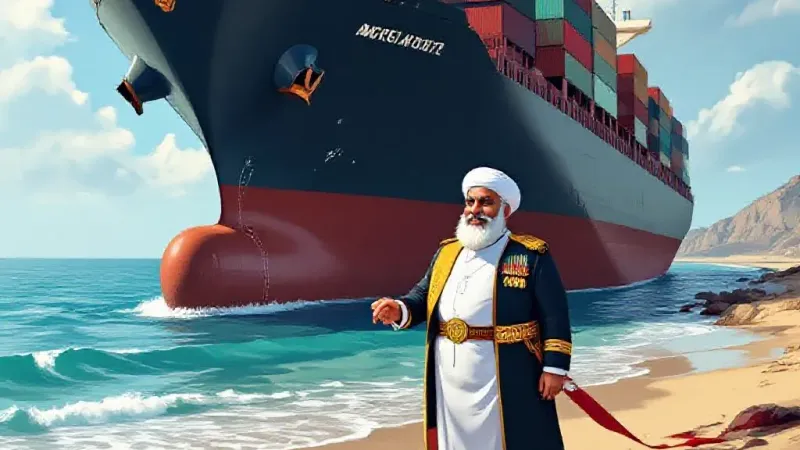
TEHRAN – An unnamed commercial vessel achieved "dynamic stabilization" in the Strait of Hormuz today, Iranian state television reported, quickly moving to clarify that the ship had not, as some "less informed" outlets might suggest, simply run aground. The incident, which saw the vessel come to a complete, unscheduled halt near a critical shipping lane, was described by official channels as an unprecedented act of "territorial contemplation" designed to enhance regional understanding.
Admiral Hossein Salami, commander of the Islamic Revolutionary Guard Corps, lauded the crew for their "impeccable execution of a complex, pre-approved navigational pause." He added, "This vessel is not stuck; it is demonstrating a profound commitment to its current location, allowing for an in-depth study of regional seabed geophysics and the subtle nuances of international maritime law from a unique, stationary perspective." Other nations, he hinted, might do well to observe this innovative approach to sovereignty as a model for future, less aggressive, displays of naval power.
Dr. Farnaz Khadem, head of the Institute for Applied Maritime Semiotics in Tehran, noted that the incident marked a significant shift in geopolitical signaling. "For too long, nations have relied on overt military exercises or diplomatic pronouncements," Khadem stated. "This 'passive-aggressive anchorage,' however, leverages the element of surprise and the inherent ambiguity of a 'grounding' to communicate a layered message. Is it incompetence? Is it a warning? Is it just a really bad GPS day? The beauty is, it's all of them, and none of them, simultaneously." She predicted a rise in "accidental-intentional" maritime events.
The vessel's crew, who state media reported were currently engaged in "spontaneous, high-level cultural exchange" with local fishing boats and "in-depth reflection on the nature of velocity," are said to be exploring the potential for a new global shipping standard where grounding is rebranded as "forced relaxation." The Ministry of Roads and Urban Development released a statement praising the ship's "courageous decision to prioritize rest and reflection over the capitalist tyranny of continuous forward motion, thus creating a serene zone of maritime mindfulness."
Critics, mostly from Western nations still operating under the "old paradigm" of not-crashing-into-things and responding directly to "groundings," suggested the incident might simply be a vessel running aground due to poor navigation. However, Iranian officials dismissed these claims as "simplistic interpretations of a multifaceted strategic narrative," emphasizing that the ship was merely waiting for the Strait to "catch up to its vision." The global shipping community is now reportedly updating contingency plans to include designated "strategic grounding zones."