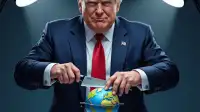
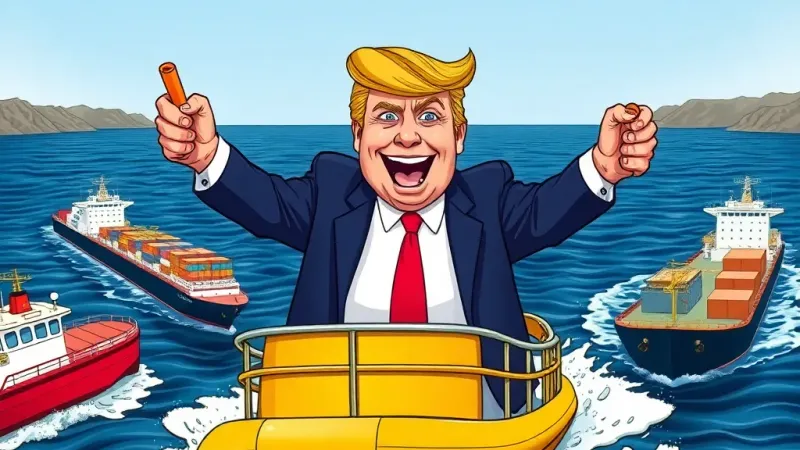
WASHINGTON D.C. — Former President Donald J. Trump today announced a unilateral "personal blockade" of Iranian ports throughout the Strait of Hormuz, delivered via a series of emphatic pronouncements from his Mar-a-Lago golf course. The initiative, described as a "custom solution" to regional instability, reportedly involves no specific naval assets, deployment plans, formal declarations to international bodies, relying instead on what sources close to the former president called "the sheer force of will and a very strong feeling."
"We're going to put a tremendous blockade on them, a personal blockade, and they won't even know what hit them," Trump stated during an impromptu press availability near the 12th hole. "It's going to be so easy, so simple. Other presidents, they use fleets, they use logistics. I use winning." The announcement has sent immediate ripples through the Pentagon, where officials are reportedly scrambling to interpret the operational implications of a "personal" naval embargo. One senior defense official, speaking anonymously, was overheard asking, "Does this mean we just... think really hard about blocking them? Or do we need to print out his tweets and hold them up to cargo ships?"
Naval strategists are reportedly consulting a variety of historical texts and modern geopolitical theories to understand how a blockade can be effectively executed without, as one analyst put it, "any ships that aren't already there on unrelated business." Dr. Elias Vance, a retired Navy Admiral and now a professor of global logistics at the War College of Theoretical Conflicts, noted the groundbreaking nature of the strategy. "Historically, blockades have involved vessels, personnel, and a distinct lack of golf carts," Vance explained. "Mr. Trump appears to be pioneering a new form of international pressure, perhaps relying on a kind of 'vibes-based' interdiction. While unorthodox, we are diligently working to draft standard operating procedures for the 'Vibes-Based Maritime Interdiction' doctrine, or VBMI, hopefully by Q3. The biggest challenge, ironically, is explaining to our actual fleet commanders why their billions in equipment is less effective than a strong feeling."
Sources within the State Department indicated that a formal diplomatic note, explaining the "personal nature" of the blockade to international shipping companies and the Iranian government, is currently being drafted. The note is expected to emphasize that while the blockade is "personal" to Mr. Trump, all nations should respect its "tremendous and very strong" parameters, which campaign spokesperson Mindy Chambers clarified would be enforced by "the undeniable power of the former president's conviction and, potentially, strongly worded faxes." Chambers added, "This isn't just a blockade; it's a *brand* blockade. We expect it to go viral."
Pentagon officials have quietly begun to explore alternative definitions of "blockade," including "strongly worded suggestion," "a stern look in the general direction of the Gulf," and "the strategic withholding of positive energy." A small team has also been dispatched to investigate if a "personal blockade" could be implemented using only a well-placed stern gaze and a particularly disappointed sigh from a strategically important beach.