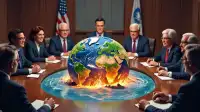
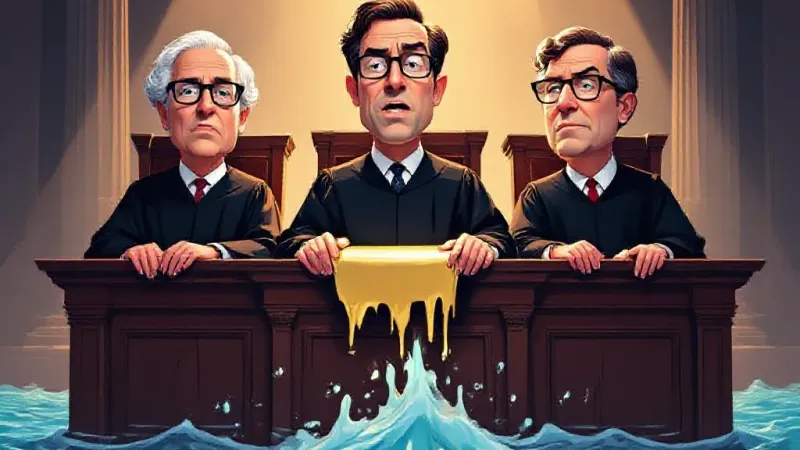
Washington D.C. — The Supreme Court heard arguments Tuesday on whether to allow a lawsuit against ExxonMobil and Suncor Energy, deliberating for over two hours on what legal scholars are calling the "complex and utterly baffling" question of corporate liability for climate change. Sources inside the courtroom described a process akin to asking a baker if bread causes toast, or a dog if chasing squirrels makes them happy. The Court's intense focus was reportedly on the precise definition of 'causation' when it involves something as nebulous as 'the entire atmosphere.'
Justice Clarence Thomas reportedly inquired, through a clerk, whether "atmospheric conditions could not, in theory, simply be having a bit of a moment unrelated to, say, the exhaust of internal combustion engines." He further questioned if an entity, by merely *providing* a widely utilized energy source, could be held accountable for 'downstream atmospheric events' that, while statistically correlative, lack direct causal agency at the point of sale. "We must consider," he continued via his proxy, "if the planet's recent thermal enthusiasm is truly linked to, what was it, 'fossil fuels'? One could argue the Earth simply 'ran a fever' and is now 'feeling better,' a natural process perhaps?"
Legal counsel for ExxonMobil, Chad Billingsworth, delivered a spirited defense, arguing that their client’s commitment has always been to meeting global energy demand. “If the planet responds in an unexpected manner,” Billingsworth stated, gesturing towards an unseasonably warm D.C. sky, “that’s hardly a failure of our product, which, by all accounts, performs exactly as advertised: it burns. Very well, in fact.” He added that holding a company responsible for the natural world’s 'overreaction' to its product would set a dangerous precedent, potentially leading to lawsuits against cloud manufacturers for rain or gravity suppliers for falls.
Dr. Evelyn Pumble, director of the newly formed 'Institute for Axiomatic Disconnect Studies,' a D.C. think tank, praised the Court's rigorous approach. "It's crucial not to rush to judgment," Pumble explained. "Attributing the rising seas to, say, the melting of ice caps, and then linking those melting ice caps directly to emissions from oil and gas — it’s a chain of logic that requires extraordinary intellectual gymnastics. One could just as easily blame tectonic shifts, or perhaps an especially aggressive solar flare, for our current predicament."
Sources close to the Court indicated deliberations were bogged down by semantic quibbles, with one justice allegedly asking for a diagram illustrating the exact process by which carbon dioxide, a colorless and odorless gas, could possibly lead to a "global warming scenario." The Court recessed, reportedly to consult with geological experts, a dictionary regarding the definitions of 'smoke,' 'fire,' and 'planet,' and perhaps a child with a crayon drawing of a smoke-stack next to a very sad polar bear.