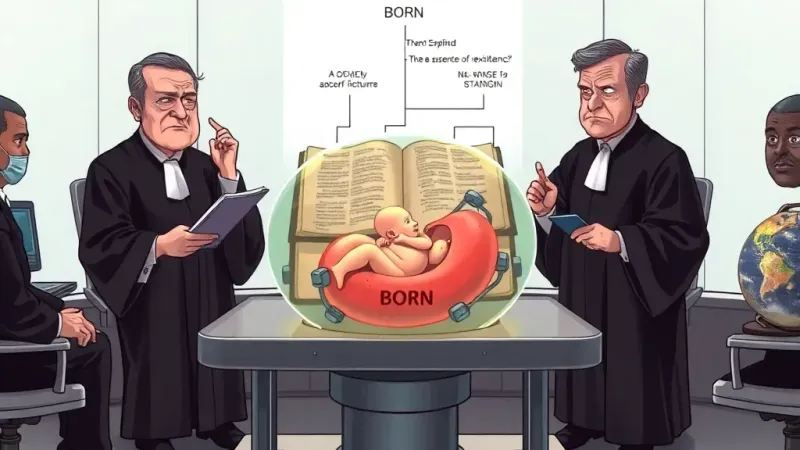
WASHINGTON D.C. — The Supreme Court announced today a new three-year, multi-phase interpretive study designed to rigorously examine whether the physical act of being born within the geographical boundaries of the United States conclusively confers American citizenship. The groundbreaking initiative, titled "Lexical Origin and Ontological Semantics of Constitutional Personhood," will draw upon an unprecedented consortium of experts to dissect the foundational language of the 14th Amendment.
Sources close to the Court indicate the initial phase alone, focusing on the precise etymology of 'jurisdiction' and the semiotics of 'subject to,' carries a projected cost of $47 million. This budget primarily covers expert testimony from historical linguists, philosophical ontologists specializing in existential identity, and a dedicated team of "conceptual cartographers" tasked with mapping the evolving "Americanness" topography. The Court’s extensive review, which legal scholars say could redefine fundamental national identity, is expected to include live-streamed public forums where citizens can weigh in on whether "born" implies "living" or merely "existing" within specific geopolitical coordinates.
"It's a surprisingly complex question once you commit to meticulously deconstructing every word until it no longer means anything useful," said Dr. Evelyn Reed, a constitutional linguist from the fictional 'Institute for Post-Meaning Legal Interpretations' who has been tapped for the project. "Sometimes the most basic things require the most rigorous intellectual gymnastics to reinterpret, especially when existing precedent proves politically inconvenient. Our goal is to ensure that by the time we’re done, no one can confidently assert what it means to be a person, much less an American."
Chief Justice Harlan Finch's office released a statement emphasizing the Court’s commitment to "a robust, unbiased inquiry into foundational concepts, free from the constraints of common sense or established historical understanding." The statement further clarified that the study aims to provide "a definitive, yet adaptable, framework for future rulings that ensures the Constitution remains a living document capable of contradicting itself in service of contemporary political objectives." Early internal memos suggest the Court is also considering parallel initiatives to ascertain whether the word "Congress" definitively refers to a legislative body or merely a large group of people arguing, and if "executive" truly implies "executing laws" or merely "exercising executive privilege."
Legal scholars anticipate a follow-up study focusing on the precise definition of "justice" itself, assuming sufficient funding can be secured before the 2028 election cycle.