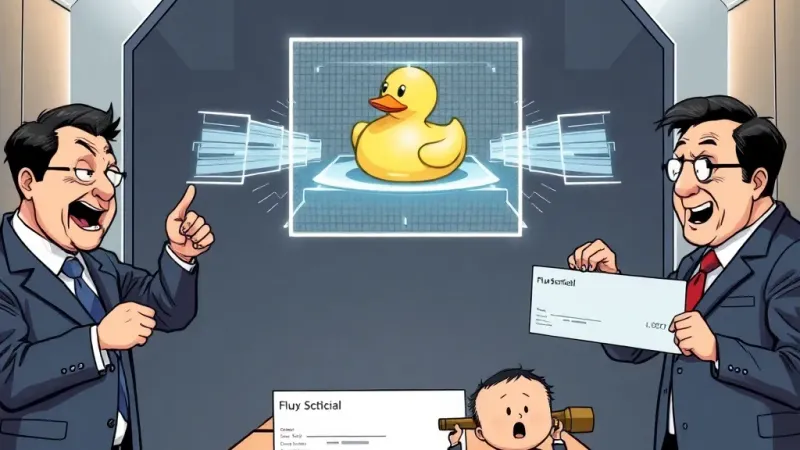
Citra Space, a Silicon Valley-backed venture, announced today it has secured $15 million in seed funding to develop cutting-edge technology aimed at identifying orbital objects, a task previously thought to be handled by a global network of telescopes, radars, and elementary school 2 projects. The company stated its 'proprietary SpaceSight™ AI' will bring unparalleled clarity to Earth's cluttered orbit, distinguishing 'what's up there' from 'what's always been up there.'
Industry veterans expressed cautious optimism, tempered by a familiar sense of déjà vu. 'We’ve been tracking space debris and active satellites since Sputnik,' commented Dr. Elara Vance, chief orbital data archivist at the International Space Registry, an organization that has, for decades, openly maintained a free-to-access catalog of over 36,000 tracked objects larger than 10cm. 'While we certainly appreciate innovation, one wonders if this new 'identification' technology will go beyond determining if Object 78453-B is indeed Object 78453-B, which, by all accounts, it has been for the last eleven years and will continue to be until it re-enters the atmosphere.'
Citra Space’s CEO, Branford 'Brad' Hayes, remained unfazed by historical context. 'Our goal isn't just to know *what* it is, but to understand its *vibe*,' Hayes stated during a press briefing, demonstrating a projected 3D model of a spent rocket stage. 'We're moving beyond mere object recognition to what we call 'orbital personality profiling.' Is this a rogue fairing with a history of unpredictable tumbles? Or a polite, stable defunct satellite simply observing the cosmos? Our machine learning algorithms, trained on billions of simulated glints and gravitational perturbations, can now differentiate between a 2-meter diameter defunct Russian SL-8 rocket body and a very similar 2-meter diameter defunct Chinese CZ-2D rocket body based solely on the subtle angular momentum of its final dying spin. It’s like facial recognition, but for space junk.'
Investors lauded the initiative, highlighting the untapped potential of charging for access to information that is currently publicly available or easily derived. 'The market for confirming existing reality in a slightly shinier package is immense,' explained Ms. Blythe Sterling, lead partner at Celestial Capital, the venture firm spearheading the funding round. 'Imagine a future where you need to send a satellite up, and you pay Citra Space a premium to confirm that the path is clear of *known* objects. It's about data validation, but with more rocket emojis. This isn't just about identification; it's about providing a 'definitive yes, that’s it' service at scale, monetizing certainty in an uncertain cosmos.'
The company plans to launch its first 'orbital affirmation' subscription service by Q3 2025, promising subscribers instant alerts if a piece of identified space debris suddenly decides to *not* be that piece of identified space debris anymore.