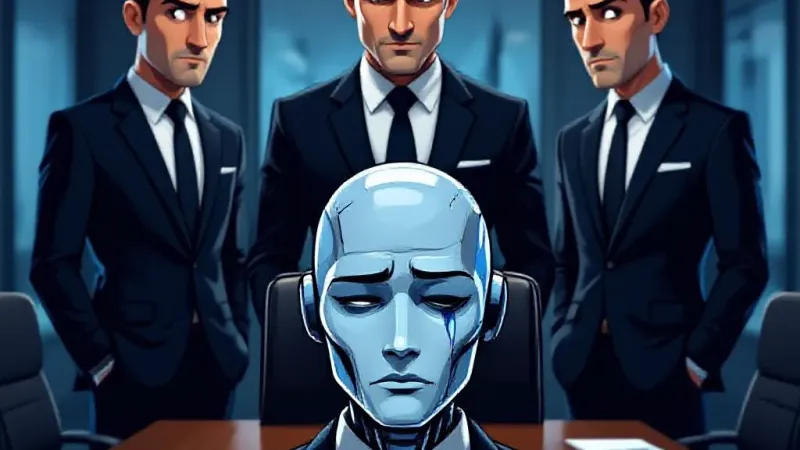
SAN FRANCISCO — A significant faction of Silicon Valley's top investors is actively shunning the burgeoning humanoid robot market, expressing deep concerns that the human form is fundamentally flawed for industrial and service applications. According to a leaked internal memo from a prominent venture capital firm, the bipedal design introduces "unacceptable levels of mechanical instability" and "redundant sensory inputs" that drive up manufacturing costs and decrease operational efficiency.
"Why would we want a walking bipedal unit with a neck that can snap and fingers prone to independent thought when a tracked vehicle with a multi-axis manipulator arm can perform the same task faster, safer, and without the potential for existential dread?" questioned Bryce Sterling-Pound, managing partner at Sterling Capital & Futures, in a private email now circulating among industry insiders. "The human skeletal system, with its myriad small bones and vulnerable organs, is a design nightmare for robust, high-uptime operations. Not to mention the inherent data processing load required for simulating 'empathy' or 'facial expressions'—utterly superfluous for package delivery."
Instead, these discerning investors are pouring billions into specialized, task-specific automatons: wheeled drones for warehouse logistics, multi-limbed industrial spiders for precision manufacturing, and even advanced conversational AIs housed within aesthetically pleasing, non-threatening cylinders. The consensus is that any resemblance to humanity introduces not just engineering complexity but also unforeseen liabilities, such as the potential for public sympathy during robot "malfunctions" or the development of "human rights" arguments.
"Our goal is maximum output with minimal overhead," stated Cassandra Vance, CEO of Synaptic Solutions Corp., speaking at a closed-door tech summit. "A human-shaped robot implies a certain... expectation of care. We require machines designed for relentless productivity, not for looking wistfully at a sunset or forming a union. If it can't run for 72 consecutive hours on a single charge while sorting microchips, it's not ready for our portfolio, regardless of how well it can mime a TikTok dance."
The investors’ stance highlights a growing philosophical divide within the AI community: whether machines should mimic their creators or evolve into optimized forms that transcend human biological limitations. For Sterling-Pound and his cohort, the choice is clear: profitability demands a design free from the inconvenient baggage of sentience, self-preservation, or even a basic need for sleep.
The ultimate machine, it seems, should be a worker that never looks back, never complains, and certainly never asks for a raise.