
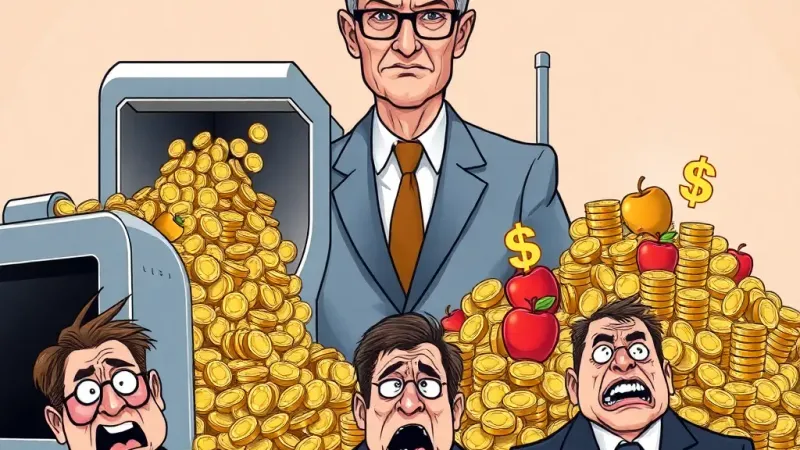
CUPERTINO, CA — In a stunning reversal of long-held tech industry dogma, a recent internal analysis by several prominent venture capital firms has confirmed that operational efficiency, strategic supply chain management, and meticulous financial oversight are, in fact, viable pathways to accumulating obscene corporate wealth. The revelation comes after Apple CEO Tim Cook’s 15-year tenure saw the company add more than $3 trillion in market value, far surpassing the growth achieved under its "visionary founder," Steve Jobs.
For years, the prevailing wisdom in Silicon Valley dictated that only a charismatic, often erratic, founder with a singular "vision" could unlock truly astronomical valuations. Companies, it was widely believed, required a touch of divine madness, frequent public meltdowns, and a penchant for launching products that users hadn't even realized they desperately needed, usually after being told they did. The notion that a CEO primarily focused on streamlining logistics and optimizing margins could achieve such staggering financial success was, until recently, dismissed as naive, bordering on delusional.
"We genuinely thought market capitalization was directly proportional to how many times you interrupted an engineer during their deep work," confessed Dr. Kendra Finch, professor of Mythic Entrepreneurship at Stanford University. "Cook’s era has forced us to reconsider the radical notion that highly competent logistical professionals might also be capable of generating mind-numbing returns without ever once proclaiming a product would 'change everything,' unless 'everything' referred specifically to quarterly earnings reports."
The sudden realization has sent shockwaves through the startup ecosystem. Venture capitalists, who previously prioritized pitches featuring dramatic pauses and vague promises of "disruption," are now reportedly sifting through résumés for candidates with "proven spreadsheet mastery" and "exceptional proficiency in margin expansion." A leaked internal memo from Apex Synergies, a leading venture capital fund, reportedly urged partners to "prioritize candidates who understand the crucial difference between EBITDA and a founder's ego, the latter being an increasingly unreliable metric for future profitability."
Industry pundits, initially quick to label Cook as merely an "operations guy," are now struggling to reinterpret his tenure through the lens of visionary genius. "We've had to completely overhaul our 'Founder Story' template," admitted Barnaby 'Buzz' Aldrin, editor-in-chief of *Disruptive Synergies Monthly*. "It turns out the compelling narrative isn't always about garage tinkering; sometimes, it's about flawlessly executed global supply chains and meticulously managed product cycles, which, we now understand, are just a different kind of magic."
The findings are expected to have a profound impact on future leadership models, with experts predicting a surge in demand for executives who can consistently deliver results without the need for constant reality distortion fields or dramatic keynotes involving U2. Some analysts are already referring to this paradigm shift as "The Cook Effect," where boring competence is suddenly recognized as an acceptable, even preferred, alternative to exhilarating chaos, particularly when it comes with a $3 trillion bonus.
Critics note that while Cook’s strategic prowess is undeniable, the iPhone now comes in 17 slightly different shades of gray, solidifying his legacy as the most lucratively beige leader in tech history.