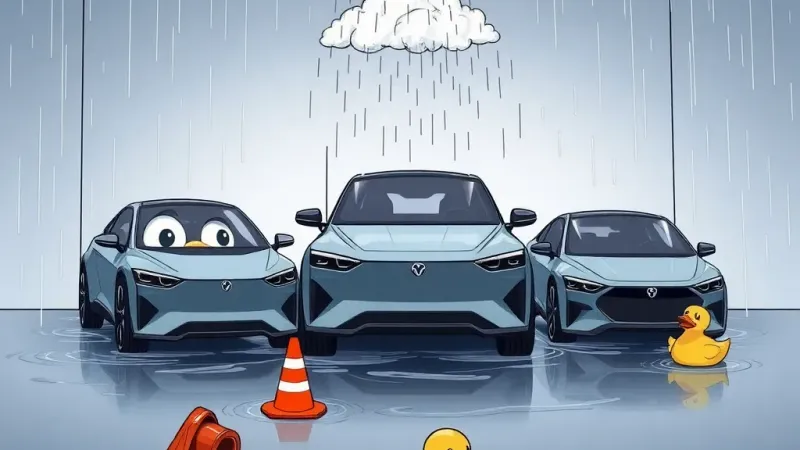
A consortium of leading tech analysts today officially declared Waymo, Tesla, and Uber as the "New Big Three" of mobility, solidifying their dominant position in a future that remains largely hypothetical. The pronouncement comes despite the combined fleet’s ongoing struggles with basic meteorological conditions and an impressive 94% human intervention rate during peak hours in beta cities, often to prevent vehicles from parallel parking directly into a row of recycling bins.
The designation, announced at the "Future of Driving, Probably" summit in Austin, Texas, signals a paradigm shift from traditional internal combustion engine manufacturers to companies primarily focused on data harvesting and the potential for a subscription-based automotive future. "It's less about moving people efficiently right now, and more about who's best positioned to charge them monthly for the *idea* of efficiency five years from now," explained Dr. Kenji Tanaka, lead analyst for Visionary Capital Insights. He added that current operational hiccups, like spontaneous lane changes into oncoming traffic during a light drizzle, or the infamous "phantom child" braking incident that briefly halted Waymo service in Phoenix last month, are simply "growth opportunities."
Waymo, with its growing but geographically constrained robotaxi service, Tesla, betting on its "Full Self-Driving" (FSD) beta that still requires active driver supervision, and Uber, with its long-term ambitions for autonomous ride-hailing, were cited for their collective market capitalization and their unparalleled ability to persuade investors that every minor software update represents a quantum leap for humanity. Industry insiders noted that while GM, Ford, and Chrysler once competed on horsepower and trunk space, the new competition revolves around who can most effectively minimize embarrassing viral videos of their vehicles getting stuck in cul-de-sacs, repeatedly attempting to park on fire hydrants, or confusing a discarded mattress for a school bus.
Sources close to the declaration committee revealed that initial criteria for the "Big Three" included a minimum of 10,000 active customer complaints related to "unexplained braking events" and at least one public apology issued for a vehicle attempting to merge with a parked emergency service vehicle. "The bar for 'innovation' is largely set by what VCs are willing to overlook this quarter," admitted a committee member on condition of anonymity, "and frankly, the old car companies just weren't generating enough compelling incident reports, like the one where a Tesla FSD vehicle tried to order a drive-thru burrito using its front camera."
Meanwhile, a spokesperson for an unnamed "Big Three" contender, speaking from a conference room equipped with several blinking 'NO INTERNET' signs, emphasized their commitment to a driverless future. "We believe consumers are ready for a world where their commute involves less driving and more politely informing a neural network that, no, that isn't the Starbucks," stated CEO Alex Chen of OmniDrive Technologies, a fictional subsidiary of one of the newly crowned giants. "Our metrics show a significant decrease in 'human driver frustration' because now the frustration is directed at a disembodied AI voice. That's progress."
The formal recognition is expected to streamline fundraising efforts for all three companies, allowing them to further develop autonomous systems that are almost certainly, eventually, going to be better than a teenager with a learner's permit.