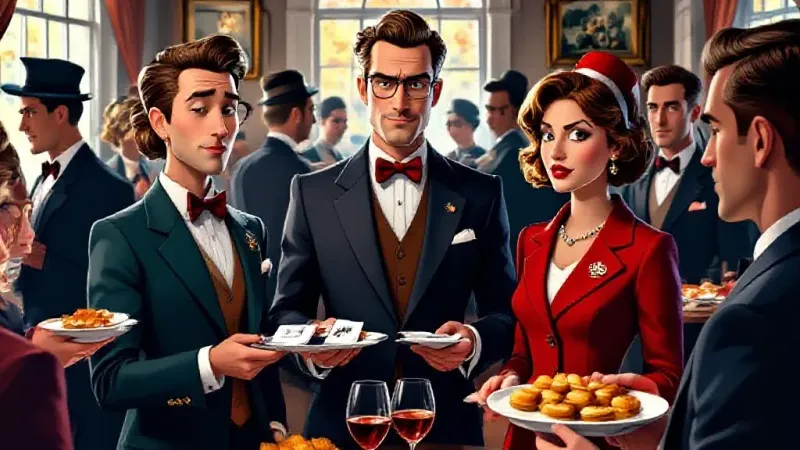
BOSTON – A recent surge of "community service," "advocacy," and "cultural connection" events across New England has been revealed by attendees to function primarily as thinly veiled networking opportunities for professionals seeking to enhance their personal brands and expand their contact lists. Participants expressed overwhelming relief that they no longer have to pretend these gatherings are solely about public good, openly admitting their primary objective is to make "strategic connections."
"Honestly, I'm here to meet the guy who runs the venture capital fund, not to ‘deepen my understanding of regional folk traditions,’" admitted Chad Kensington, a 34-year-old marketing consultant clutching a locally sourced artisanal kombucha. Kensington, who was spotted discreetly scanning name tags during a moving performance of traditional interpretive dance, added, "It's perfect. You get to look philanthropic, land a potential client, and get a solid tax write-off in one fell swoop. My wife thinks I’m a saint, and my Q4 projections just got a boost. Win-win-win."
Event organizers, speaking anonymously to Hambry, confirmed the trend. "We frame it as 'building bridges' or 'fostering dialogue,' but what we're really doing is creating a low-pressure environment for mid-level executives to connect with board members and for small business owners to pitch their services," explained one organizer from the "Greater Boston Coalition for Unified Regional Harmony." "The 'cultural connection' elements are just set dressing. They make for excellent Instagram stories, which in turn drive attendance from people who want to be seen at those events. It’s a self-sustaining ecosystem of mutual career advancement, all under the guise of civic engagement."
Another organizer, planning an upcoming "Harmony Through Heritage" festival, detailed the subtle art of facilitating these exchanges. "We strategically place the hors d'oeuvres near the high-value donors and ensure the 'immersive cultural experience zones' have adequate lighting for LinkedIn headshots. The actual service component? That's typically outsourced or condensed into a 30-minute 'feel-good' segment just before the keynote address, allowing ample time for post-speech mingling with minimal distraction."
Dr. Eleanor Vance, a sociologist from the Institute for Aspirational Proximity Studies, stated, "Our research indicates that the average participant at these events makes eye contact with the keynote speaker for precisely 4.7 seconds while subtly angling their smartphone to capture a selfie that includes both the speaker and a prominent event banner. The 'community impact' metric, once tied to actual volunteer hours, is now almost entirely correlated with the number of new LinkedIn connections made within 24 hours of the event's conclusion and the engagement rate on their subsequent 'proud to have supported X' social media posts."
The next wave of New England events promises even more opportunities for "meaningful engagement," with several organizers confirming dedicated "networking-adjacent cultural experiences" designed to maximize professional overlap while minimizing actual human connection beyond a purely transactional basis. This strategic approach ensures that every moment, from the lukewarm coffee to the earnest musical performance, serves a higher, more personal purpose.
So, come for the "advocacy," stay for the awkward moment you hand a CEO your business card while they’re trying to enjoy a silent auction bid, secure in the knowledge you've performed your civic duty.