
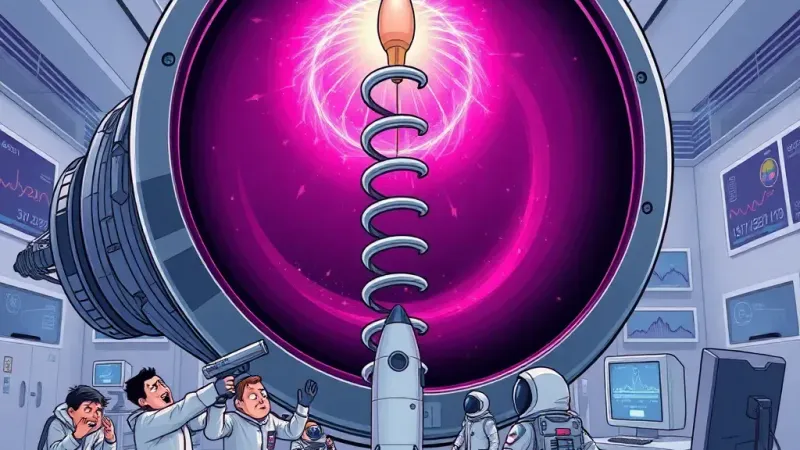
HOUSTON, TX — In a dramatic shift in priorities, the National Aeronautics and Space Administration (NASA) has officially identified the battery ejection spring mechanism as the single greatest, yet most underestimated, threat to the Artemis lunar missions. The re-evaluation comes after a widely circulated video from internal training, showing astronaut Christina Koch demonstrating a battery swap for the Orion spacecraft, resulted in the power cell rocketing across the module with unexpected force and velocity.
“For decades, we’ve poured billions into mitigating solar flares, micrometeoroid impacts, and the psychological toll of deep space isolation,” stated Dr. Kaelen Vance, lead propulsion systems engineer at Johnson Space Center, during an emergency press conference. “Turns out, the real unknown variable was always sitting there, coiled within our own hardware, waiting to strike. The sheer, untamed power of a perfectly calibrated compression spring is, frankly, terrifying.” Dr. Vance noted that the incident revealed an “egregious oversight” in risk assessment, where simple mechanics were overshadowed by more ‘glamorous’ space hazards.
NASA has immediately launched "Project Guardian Spring," an initiative diverting approximately $7.3 billion from existing infrastructure upgrades to develop advanced spring containment fields and predictive recoil algorithms. Initial findings from the task force indicate that the energy stored within a standard lithium-ion battery ejection spring could, under specific lunar gravity conditions, propel a 2-kilogram object at speeds approaching 25 meters per second, creating an "unacceptable interior ballistic hazard." Furthermore, preliminary simulations suggest that an improperly secured spring could potentially damage critical life support systems, or, in a worst-case scenario, achieve escape velocity from an open hatch, rendering it an untracked projectile in Earth orbit.
Sources within the agency, speaking anonymously due to the sensitive nature of spring-related trauma, confirmed that future mission checklists will now feature extensive pre-ejection spring calibration and mandatory "spring-aware" hazard zones. Astronaut training will incorporate advanced hand-eye coordination drills specifically designed to anticipate and counter the "feral rebound dynamics" of these miniature catapults. “We now understand the universe has a sense of 2, and that humor often manifests as an unexpectedly forceful spring at the most inconvenient times,” said NASA spokesperson Evelyn Reed, while subtly flinching at the sight of a desk stapler.
Industry experts suggest the move signifies a broader shift in institutional thinking, acknowledging that the most sophisticated problems often arise from the most mundane components. Future astronauts will now undergo extensive 'spring awareness' training before ever stepping foot in a multi-billion dollar spacecraft.
Hambry is a satire publication. All articles are works of fiction.