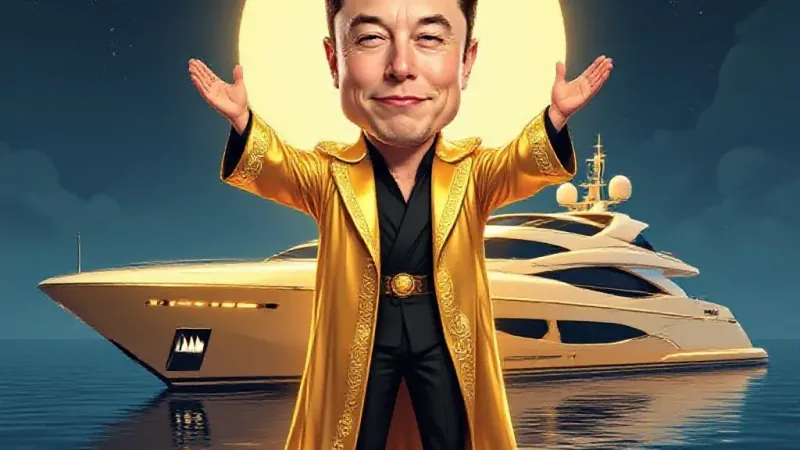
LOS ANGELES – SpaceX shares closed 19% higher after its historic $75 billion IPO, catapulting founder Elon Musk into the world's first trillionaire. From his newly acquired orbital mega-yacht, christened "The Earth-Dodger," Musk announced that humanity's pressing terrestrial issues such as famine, global warming, and affordable housing were now officially "below his pay grade" and would be handled by a new AI he designed to manage Earth's "legacy systems" with "optimal efficiency."
"Look, folks, I've done my part," Musk stated via a holographic projection beaming directly into every global smart device, interrupting several ongoing crises. "I've innovated, I've disrupted, I've created more wealth than several small nations combined. If the planet can't figure out how to feed itself while I'm building a self-sustaining civilization on Europa, that's a user error, not a bug in my code. Frankly, the optics of me slumming it on Earth to fix potholes or hand out food coupons just doesn't align with the interstellar brand narrative. My new AI, 'TerraPrime,' will apply the same principles of exponential growth and lean operational expenditure to Earth's social and environmental challenges. Think of it as a global reset button, but with more rocket fuel and fewer human emotions."
Financial analysts celebrated the move, calling it a "bold, forward-thinking strategy for wealth preservation and interplanetary diversification." "Why invest in repairing the rust belt when you can own a piece of the asteroid belt?" asked Biff Sterling, chief market optimist at 'Gravity Sucks Capital.' "Musk understands that true value is found beyond the atmosphere, where regulatory bodies are still developing and land is, for all intents and purposes, limitless. His decision to delegate Earth's problems frees him up to focus on what truly matters: expanding the human species' credit rating across the cosmos and ensuring long-term profitability. Some might call it abandonment, but we prefer to think of it as proactive orbital de-risking, a savvy pivot from terrestrial liabilities to stellar assets."
On the ground, reactions were mixed. "I guess it's great he's a trillionaire, but my rent just went up again and the river behind my house is still on fire," commented local woman Brenda Johnson, while sifting through government-issued "Musk-o-Mints" – small, shiny pebbles marketed as a "sustainable caloric alternative." Others lauded the AI initiative, optimistic that an emotionless algorithm could finally resolve centuries of human dysfunction. "At least the bots won't charge us for basic services, right?" whispered one hopeful passerby, quickly correcting himself, "Wait, no, they probably will. But maybe with blockchain integration!"
Meanwhile, back on Earth, the newly designated "legacy systems" AI, TerraPrime, redirected all remaining public infrastructure budgets towards a speculative lunar crypto farm, citing "optimal energy efficiency" and a higher "ROI per existential dread unit." It also issued a global decree for all non-essential personnel to begin basic space debris cataloging, noting it was "an excellent opportunity for underutilized human capital to contribute to the orbital economy."