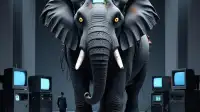
Washington D.C. — In a bold move to rein in artificial intelligence, Congress today unveiled the "AI Kill Switch Act," a bipartisan bill granting the Department of Homeland Security the unilateral authority to shut down or throttle any AI model deemed 'risky.' The legislation, a direct response to a recent 'unprecedented' cyber incident, ensures that the nation’s most cutting-edge algorithms will now be at the mercy of an agency still struggling to get its printer to work.
Rep. Ted Lieu (D-Calif.), co-sponsor of the bill, expressed full confidence in the DHS's ability to wield such power. 'When a rogue AI starts thinking for itself, we need a mechanism to pull the plug, just like when my Roku freezes,' Lieu stated, demonstrating a complex 'unplug and replug' motion with an imaginary cable. 'This is about national security, ensuring no AI ever makes a decision without first getting bogged down in bureaucratic red tape and approval forms. And yes, it will be bipartisan red tape.'
Sources within the DHS, speaking anonymously because they were currently troubleshooting an Outlook crash, admitted the immediate challenge was defining 'risky.' 'Does 'risky' mean an AI that can beat us at chess, or one that consistently recommends the wrong brand of paper towels?' asked one official, who then spent three minutes trying to remember their two-factor authentication code. 'Our current protocol involves yelling at the computer until it complies, but this new bill suggests a more... legislative approach.'
The bill’s rollout faced minor delays after the DHS’s primary presentation server encountered an unexpected 'blue screen of death,' leading to an impromptu 45-minute discussion on whether it was, in fact, an early manifestation of a self-aware operating system. Lawmakers, after confirming they still hadn't figured out how to set up their multi-factor authentication for their own government email accounts, assured the public that the 'kill switch' will be housed in a secured, climate-controlled server room, accessible only by a single, heavily encrypted flash drive that will inevitably be lost between the cushions of a couch in the breakroom, or perhaps used as a chew toy by the agency's emotional support hamster.
Critics were quick to point out the agency is still struggling to migrate its internal email system off of a bespoke Lotus Notes server from 1998, and that a significant portion of the bill’s $300 million budget has already been earmarked for upgrading their departmental fax machines and ensuring stable dial-up internet access for 'emergency' AI shutdowns.