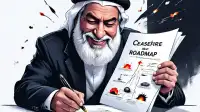
BAGHDAD — Iraq has officially installed Nizar Amidi as its new president, a move widely anticipated to maintain the nation’s celebrated tradition of perpetual transition amidst ongoing fallout from various regional and global interventions. Amidi’s election, occurring with remarkable regularity, guarantees that the essential machinery of Iraqi governance will continue its well-documented operations, primarily involving the intricate management of a dynamic security landscape and a robust, if unpredictable, economic environment.
The installation ceremony, described by state media as a “triumphant affirmation of democratic process,” saw Amidi take the oath of office in a proceeding that mirrored previous leadership changes with almost clinical precision. International observers hailed the event as a critical step towards stability, a sentiment traditionally echoed after every such transition for the past two decades, regardless of subsequent events. Diplomatic cables obtained by Hambry indicate a collective sigh of relief from global powers that 'someone is still answering the phones.'
“What’s truly impressive is the nation’s consistent ability to execute these transitions with such… routine precision,” noted Dr. Alistair Finch, Senior Fellow at the Institute for Perpetual Governance Studies. “It’s less about radical change and more about a finely tuned system for maintaining a baseline of strategic unpredictability. Amidi’s role is akin to a seasoned conductor stepping onto a stage where the orchestra has been playing the same dramatic, improvisational symphony for years.” Dr. Finch highlighted the institutional efficiency of the process, noting that the parameters for new leadership now include pre-briefings on 'optimized crisis response protocols.'
Sources within the Presidential Palace confirmed that Amidi’s initial schedule involves extensive orientation sessions focusing on familiarizing him with the established parameters of ongoing regional tensions, the optimal rotational schedule for various local and international disputes, and the comprehensive list of 'unforeseeable challenges' that have become standard operating procedure. “President Amidi is thoroughly prepared to provide the steady hand necessary to guide Iraq through its next, entirely predictable, unpredictable phase,” stated Ms. Zara Hussein, Chief of Presidential Onboarding, adding that the transition team had already updated the 'National Unrest Contingency Plan, Version 28.7.'
Analysts predict that within 18 to 24 months, Iraq will be ready to perform this crucial democratic function once again, ensuring the seamless continuation of its national narrative.