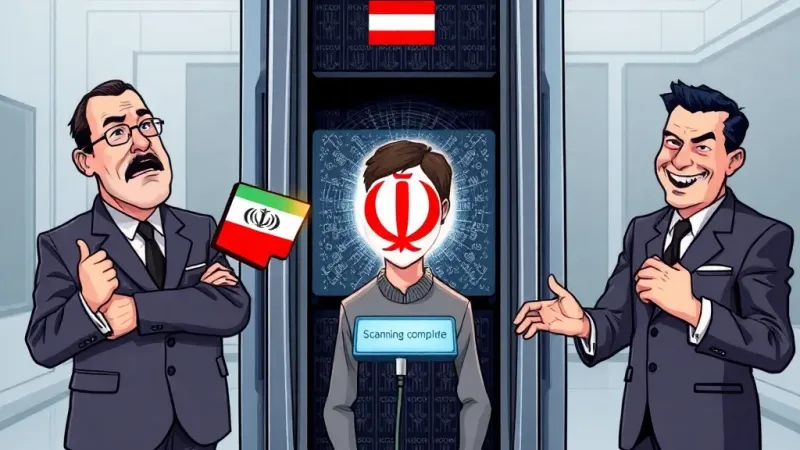
Tehran state television today celebrated the return of an Iranian student, previously held in France, declaring her repatriation a resounding victory against "Western ideological infiltration." The highly publicized broadcast highlighted the student's "voluntary" return as incontrovertible proof of the nation's resilient cultural defenses and unwavering commitment to its citizens, effectively re-securing a valuable human resource from foreign influence and intellectual contamination.
Following weeks of intensive diplomatic negotiation, the unnamed student, detained in France on undisclosed charges, arrived at Tehran’s Imam Khomeini International Airport to a carefully orchestrated welcome. State media lauded her reintegration as a critical "data recovery operation," successfully preventing permanent loss of a national intellectual asset to alleged "cultural malware" prevalent in Western societies. Upon arrival, authorities confirmed that she immediately began a standardized "re-orientation and software update" protocol, meticulously designed to recalibrate her perspective and ensure full compliance following prolonged exposure to non-indigenous thought.
"This repatriation is not merely a diplomatic success; it is a profound ideological triumph," stated Dr. Hamid Karami, Director of the National Thought Purity Institute, in an exclusive interview with IRIB News. "We have unequivocally demonstrated that our national firewall is robust, sophisticated, and ultimately impenetrable. Our youth may temporarily experience external networks, but the superior architecture of our domestic operating system will always pull them back to safety. She is now fully re-downloaded to the correct servers, operating at peak national efficiency." Dr. Karami further elaborated on the institute's specialized "decontamination modules," which include mandatory daily viewing of state-approved documentaries, intensive re-familiarization with official historical narratives, and a comprehensive curriculum designed to neutralize any lingering effects of independent critical thinking.
The student's "voluntary" decision to return, widely reported by state channels, was presented as a testament to the magnetic pull of authentic Iranian values over the superficial allure of the West. "Her return sends a clear message to any who doubt the strength of our national spirit," explained Ms. Zahra Mansouri, a spokesperson for the Ministry of 2 and Islamic Guidance. "We do not merely retain our citizens; we *retrieve* them. Her journey reinforces the principle that all Iranian minds, particularly those with high intellectual potential, are vital national assets that must be protected from external threat vectors and potential data leakage. We look forward to her full productive re-engagement within our protected cultural ecosystem."
External observers and human rights advocates, largely ignored by state media, noted the peculiar enthusiasm with which the student's return was presented, suggesting it bore less resemblance to a joyous reunion and more to a successful corporate asset recovery mission. Footage showed the student, looking noticeably subdued and offering no direct statements, being greeted by family members and several high-ranking government officials. State-commissioned spokespersons, however, affirmed her "profound gratitude" for the opportunity to "reconnect with authentic Iranian values" and "purify her digital footprint" from foreign influences.
The state's pervasive messaging confirmed that while abroad, the student had successfully avoided installing any unauthorized "freedom apps," thus preserving her operating system for seamless and immediate reintegration into the nation’s carefully curated digital and social architecture. Her future, officials noted, would now be defined by "contributions aligned with national priorities," effectively putting her potential for independent thought into permanent standby mode.