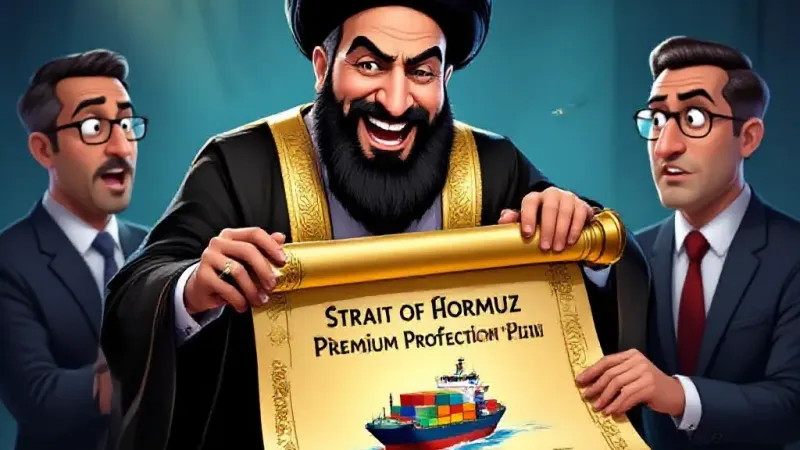
Tehran officially announced its new "Strait of Hormuz Premium Protection Plan" today, a groundbreaking initiative designed to "streamline maritime safety and ensure unhindered global trade." The comprehensive program, projected to generate an estimated $20 billion annually, proposes a mandatory "user-based security assessment" for all vessels transiting the vital waterway.
"This isn't about profit; it's about partnership," stated Hossein Salami, Commander-in-Chief of the Islamic Revolutionary Guard Corps, speaking from a newly constructed "Maritime Engagement Logistics Center" overlooking the Strait. "For too long, the international community has benefited from our generous stewardship of these waters without contributing equitably. Our new plan ensures a stable, predictable operational environment for everyone. Think of it as a subscription service for peace of mind, with an iron-clad guarantee of no unforeseen 'incidents' for our valued clients."
While details of the fee structure remain unclear, early estimates suggest major oil tankers could face charges in the tens of millions per transit. The plan includes tiered benefits, ranging from basic transit clearance to "Concierge-Level Escort Services" for high-value cargo, promising to "resolve any navigational ambiguities" swiftly and "mitigate unexpected delays caused by regional geological activity or stray fishing vessels."
International shipping consortiums expressed "cautious optimism" regarding the proposal, with one anonymous CEO noting, "It's certainly a creative approach to resource allocation. We're currently modeling the ROI of preemptive payment versus the historical cost of 'unplanned diversions' and 'spontaneous hull integrity tests'." Analysts at the Institute for Global Maritime Financial Optimization (IGMFO) quickly reclassified the Strait of Hormuz from a critical choke point to a "premium-access economic corridor," predicting other strategic waterways might soon adopt similar "localized revenue generation strategies."
"This could revolutionize international maritime governance," observed Dr. Kaelen Vance, lead geoeconomic strategist at the IGMFO. "Imagine the Panama Canal offering 'fast-pass' protection from 'unfortunate lock malfunctions,' or the Suez Canal providing 'anti-grounding insurance' directly from Cairo. It's simply monetizing existing, often implicit, control."
Critics, however, pointed out the plan bears a striking resemblance to a mob protection racket, but Iranian officials quickly dismissed such comparisons, insisting their services offered a "much more structured and digitally integrated invoicing system, complete with blockchain-verified compliance certificates."