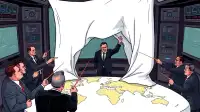

WASHINGTON D.C. – The International Monetary Fund (IMF) and World Bank are gearing up for their highly anticipated annual meetings this week, where delegates from 190 member countries are expected to 'grapple' with the familiar specters of global inflation and economic growth, sources confirm. The week-long event promises extensive discussions, panel sessions, and closed-door meetings dedicated to identifying and acknowledging problems that have persisted with remarkable consistency since the institutions' inception.
Economists predict a groundbreaking consensus will be reached that prices are, in fact, rising, and that economic growth is, in fact, desirable. A preliminary agenda outlines a series of presentations on "the current state of rising costs" and "strategies for future economic expansion," hinting at a continuation of the critical discourse that has defined these gatherings for decades.
"We anticipate a robust re-affirmation of core economic principles," stated Dr. Alistair Finch, head of Global Economic Reassessment at the World Bank, in a pre-conference briefing. "Our experts are poised to confirm, with unprecedented rigor, that inflation erodes purchasing power and that sustainable growth remains a key objective. These are not easy truths, and it takes dedicated annual effort to keep them at the forefront of global policy discussions." When pressed on potential new solutions, Dr. Finch clarified, "Our primary role is to ensure these issues are consistently recognized as issues. Innovation often follows recognition."
Sources close to the organizing committees suggest that a significant portion of the week's proceedings will focus on optimizing the language used to describe economic challenges. Workshops titled "Advanced Synonyms for 'Uncertainty'" and "Maximizing Impact of 'Concerning' in Official Communications" are reportedly oversubscribed. Delegations are also expected to spend considerable time debating whether to characterize the current global economic outlook as "challenging," "volatile," or the more provocative "a bit tricky." The choice of terminology, according to one anonymous senior delegate, "can significantly impact the perceived urgency, without, you know, actually changing anything."
Another critical component of the meetings will be the presentation of a new, highly detailed report confirming that the world’s poorest nations continue to struggle with poverty, a finding that analysts suggest will provoke "grave concern" among attendees before they return to their respective capitals. The report, titled "Surprise! The Poor Are Still Poor," offers updated figures on the scale of global inequality, prompting one pundit to speculate that next year’s meeting might address how these updated figures might be further updated in the future.
The meetings are expected to conclude with a joint statement pledging continued vigilance and the scheduling of next year’s gathering to address these same persistent and ever-so-slightly-more-complex issues.