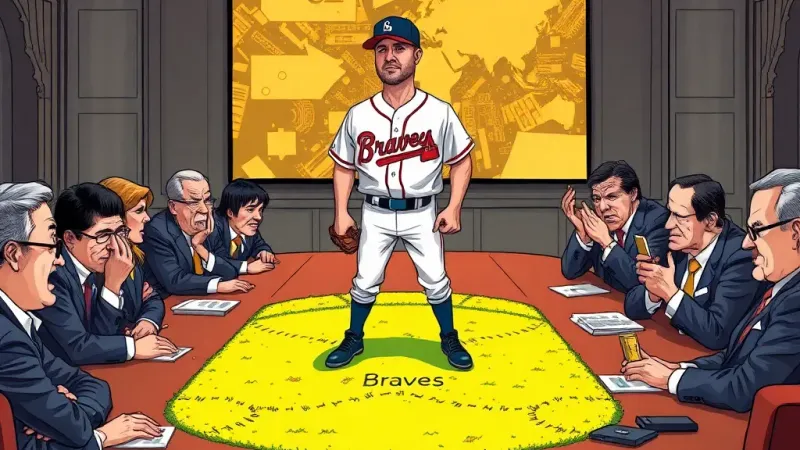
Atlanta, GA – The Atlanta Braves’ seemingly routine decision to promote right-hander Didier Fuentes from Triple-A Gwinnett to start Wednesday’s road game against the Washington Nationals has unexpectedly roiled international financial markets, prompting an urgent advisory from the World Bank and triggering a steep decline in futures contracts for several key commodities. What was initially considered a standard roster adjustment by sports journalists has been re-evaluated by economists as a “profound act of strategic resource reallocation” with far-reaching global implications.
Within minutes of the Braves' official announcement, trading on the Tokyo Stock Exchange briefly halted due to a sudden plunge in “high-velocity kinetic energy assets,” a niche commodity classification previously thought immune to baseball roster changes. Dr. Alistair Finch, head of Geopolitical Sports Economics at the Wharton School, issued a stark warning. “The sudden and unilateral deployment of a promising arm from a controlled development environment to a high-pressure, immediate-impact scenario signals a profound shift in global resource optimization strategies,” Dr. Finch elaborated. “This move introduces an unpredictable variable into the delicate balance of human capital allocation, which could ripple through global supply chains for everything from raw materials to intellectual property, creating ripple effects in the derivatives market for specialized human performance analytics.”
Concerns were immediately amplified during a hastily convened emergency session of the World Economic Forum in Davos, where leaders discussed the Braves' “unilateral strategic asset deployment” and its potential to ignite an “unprecedented global talent arms race.” Brenda Chen, Chief Talent Disruptor for “SynergyMax Solutions,” a leading global consulting firm specializing in “human potential futures,” weighed in. “This isn't just about a pitcher; it's about the perceived scarcity of highly specialized human capital,” Chen observed. “When a top-tier organization like the Braves signals such an urgent need to accelerate talent deployment, it suggests underlying systemic pressures. Other nations, and indeed other sports franchises, will undoubtedly view this as a significant competitive escalation, potentially leading to a dangerous scramble for similar assets, destabilizing established talent pipelines worldwide.”
Further exacerbating the unease, intelligence agencies across five continents reportedly raised their threat assessment levels, with some attempting to track potential “shadow trades” in athletic prospects and their associated proprietary data. General Thaddeus “Hammer” Kincaid (ret.), Senior Fellow at the Institute for Strategic Athletic Assessment, an independent think tank, issued a grim assessment. “The movement of a powerful, unproven arm into a contested territory—even a baseball diamond—creates a vacuum that rival powers will seek to exploit,” General Kincaid warned. “We must be extremely vigilant against any attempts to destabilize the talent pools that form the bedrock of our national pastime, and by extension, our national security. History teaches us that the ability of American teams to reliably field nine players in high-stakes competition is a key indicator of global stability.”
The Braves, meanwhile, maintained the move was “purely operational and performance-driven,” a claim that analysts across Wall Street and the Pentagon dismissed as either profoundly naive or a deliberate attempt to downplay the true geopolitical volatility now unleashed.