
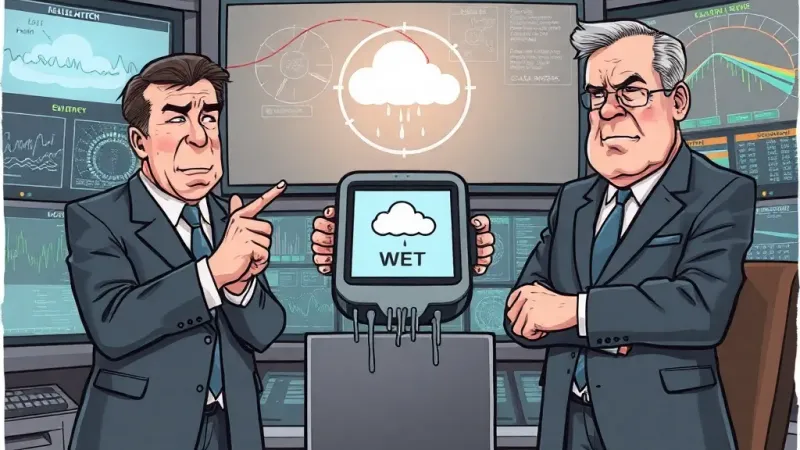
WASHINGTON D.C. — The Biden administration today announced the activation of a novel 'Wet Watch' protocol, establishing a nationwide advisory in anticipation of what meteorologists are now classifying as "multiple, cascading atmospheric moisture events" slated for Monday and Tuesday. The unprecedented initiative, codenamed 'Project Monsoon,' aims to coordinate federal, state, and local responses to consecutive periods of precipitation.
"The sheer audacity of two back-to-back rain fronts demands an integrated, proactive approach," stated Director Evelyn Reed of the newly formed Office of Hydration Preparedness and Resilience (OHPR) during a somber press briefing. "This isn't just about umbrellas and galoshes anymore. We're talking about sequential saturation risk, potential disruption to outdoor brunch plans, and an alarming increase in demand for premium indoor activities. The American people deserve a government that can strategically pivot from 'wait-and-see' to 'wet-and-respond.'"
Under the 'Wet Watch' framework, which was fast-tracked through Congress as an amendment to the 2025 National Preparedness Act, states are encouraged to deploy 'Puddle Patrol' units equipped with squeegees and cones to mark particularly deep accumulations. Additionally, the Department of Homeland Security has issued a 'Tier Three Atmospheric Engagement' alert, advising citizens to remain calm and perhaps consider purchasing a new streaming service subscription. "We've run simulations," Reed confirmed, "and frankly, the data on consecutive dampness is far more complex than a single, isolated downpour. It requires foresight, resource allocation, and a robust inter-agency karaoke contingency plan."
Local meteorologist Dr. Arlo Finch, speaking from his notoriously dry basement, expressed bewilderment at the federal response. "It's… it's just rain. A couple of systems rolling through, like they do every spring. We call that 'weather' in the civilian sector," Dr. Finch remarked, wiping a smudge from his glasses. "I'm more concerned about the taxpayer dollars funding the 'National Towel Reserve' than the actual precipitation. Are we going to need a federal agency for 'Slightly Breezy Day' next?"
Despite skepticism, the administration maintains 'Project Monsoon' is a vital step toward future-proofing the nation against routine atmospheric occurrences. The 'Wet Watch' is expected to cost approximately $4.7 billion in its inaugural week, primarily allocated to feasibility studies on advanced moisture diversion techniques and a public awareness campaign featuring animated droplets wearing raincoats. Citizens are reminded that while the federal government is handling the strategic response, personal responsibility for bringing in garden gnomes remains paramount.
Experts predict the 'Wet Watch' protocol will be swiftly downgraded to a 'Moist Advisory' by Wednesday morning, clearing the way for the development of 'Operation Sunny Skies' for the weekend.