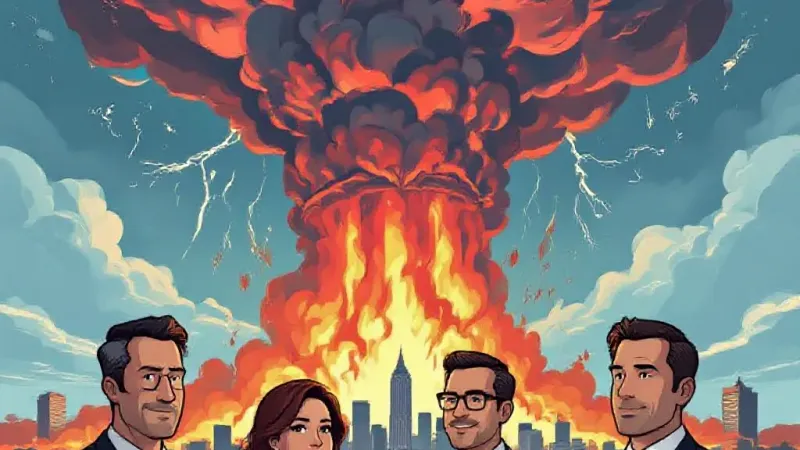
South Bend, IN – A catastrophic commercial building fire raging for over 24 hours has been officially reclassified by regional environmental authorities as a "significant localized atmospheric modification event," with experts scrambling to model its implications for the upcoming severe weather season. The blaze, which consumed the former industrial complex, is now projected to have a quantifiable, if not entirely understood, impact on everything from local precipitation to tornado formation potential.
"This isn't just a fire anymore; it's an uncontrolled experiment in atmospheric geo-engineering with real-time feedback loops," stated Dr. Kendra Thorne, lead climatologist for the newly formed Institute for Regional Atmospheric Disruptions (IRAD), while sifting through real-time particulate matter data displayed on a portable holographic projector. "We're seeing aerosol concentrations and thermal plumes that could realistically shift the local jet stream two to three miles, potentially causing a minor hurricane to spontaneously form over Lake Michigan, or at the very least, disrupt key agricultural growing seasons throughout the tri-state area. Or, you know, just a really bad thunderstorm." Thorne emphasized that the economic cost of the building itself was now secondary to the potential for "unplanned climate intervention," urging state governors to prepare for unprecedented climate model recalibrations.
Meanwhile, the burning structure's owner, who wished to remain anonymous to avoid "unnecessary stakeholder engagement and value erosion," revealed that preliminary calculations indicate the fire has already released enough carbon dioxide to qualify for several years' worth of voluntary emissions credits, should the right regulatory framework emerge. "We're not just losing a tangible asset," a spokesperson for the owner clarified via encrypted corporate messaging channel, "we're inadvertently contributing to the global carbon cycle, which, from a certain perspective, is a very impactful thing to do on a macro-environmental scale. We view this as an unbudgeted, large-scale carbon sequestration opportunity gone awry." They assured the public that all necessary data for future carbon credit monetization was being meticulously collected by a third-party environmental consulting firm.
Emergency services on the ground, still battling the inferno with dwindling resources, acknowledged the scientific significance but expressed difficulty securing additional water and personnel. "We asked for more water tankers and a bigger ladder truck; they sent us a drone with an atmospheric sensor array and three climate modelers with iPads," lamented Fire Chief Doug ‘Smokey’ Miller, wiping soot from his perpetually tired brow. "Apparently, tracking the fire's 'radiative forcing' and 'tropospheric ozone precursor release' is now more critical than, you know, putting out the actual fire itself. We're running out of foam, but we've got fantastic data on the plume's trajectory." He added that several meteorologists had arrived, armed with clipboards and very serious expressions, demanding an optimal viewing spot for cloud formation studies and arguing over the best angle to deploy their laser scintillometers.
As acrid smoke, now officially designated a "localized climate feedback loop," blanketed the city, residents were advised to stay indoors, not primarily for fear of toxic fumes, but to avoid inadvertently influencing the carefully calibrated meteorological models with their own human breath and ambient body heat, thus preserving data integrity for future grant applications.