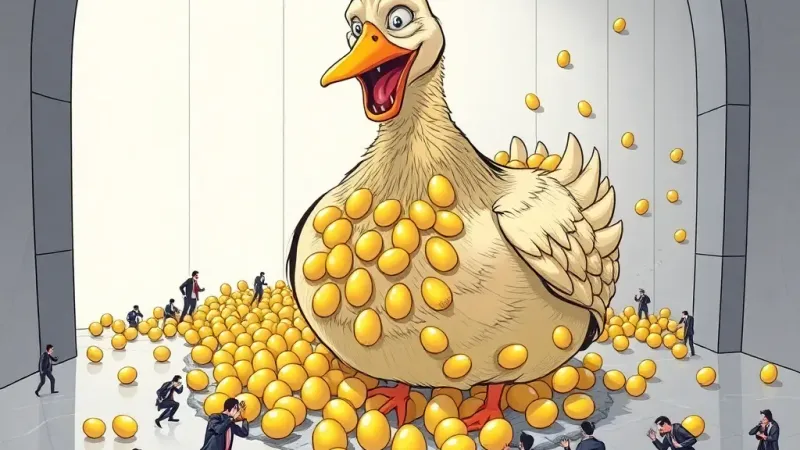
It's been quite the spectacle watching the so-called financial experts scratch their heads over Goldman Sachs. "Record equities trading!" they shriek, "Second-highest quarterly revenue ever!" And yet, the stock tumbles. They're baffled, utterly flummoxed, because they refuse to see the obvious truth staring them right in their spreadsheets: Goldman Sachs is *too good*.
Yes, you heard me. Too good. The market, my friends, is not a simple calculator. It has a soul, a fickle spirit that thrives on the *narrative* of growth, not its actual, boring conclusion. When a company, particularly one of Goldman's stature, hits "record" anything, it's not a sign of strength; it's a flashing red beacon screaming, "We’ve peaked! There’s nowhere left to go but down!"
Think about it logically. What captures the imagination more: the valiant underdog fighting its way to the top, or the undisputed champion who already has all the belts? Investors are dreamers, not chroniclers. They want to buy into the *potential*, the promise of future gains, the thrilling ascent. Goldman Sachs has just posted results that suggest they've reached the summit. And what does the seasoned mountaineer do after reaching the summit? They begin their descent. It's not pessimism; it's simply the law of peaks and valleys, applied to the ethereal realm of investor psychology.
All these talking heads blather on about "fundamentals" and "economic indicators." Piffle! They're missing the forest for the trees, or rather, the soul for the algorithms. The market doesn’t want perfection; it wants *story*. It wants struggle, the possibility of triumph, the thrill of the chase. Goldman Sachs, in its ruthless efficiency and relentless profit-seeking, has, frankly, become boring. They've optimized themselves out of the thrilling narrative that fuels sustained stock growth. You can’t keep investors excited when you’ve already achieved maximum excitement.
So, what’s a behemoth like Goldman Sachs to do? My advice is simple, yet revolutionary: Strategically underperform. Yes, you heard me. Perhaps next quarter, aim for a "moderately impressive" performance. Leave a little on the table. Create some buzz about "unexpected challenges" that you heroically overcome the quarter *after* that. Give the market something to hope for, something to *believe* in again, rather than just cold, hard, uninspiring perfection. Because in the unpredictable dance of the stock market, being too good is often the fastest route to being misunderstood, undervalued, and ultimately, falling from grace. The market is clearly telling them: learn to love a little imperfection.