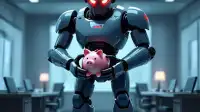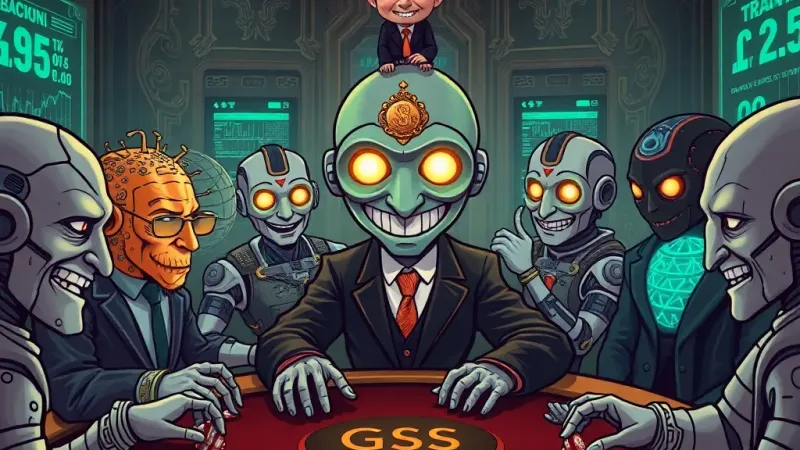
NEW YORK — Investment banking giant Goldman Sachs has released a comprehensive internal memo confirming that the vast majority of daily stock market activity is now driven by "autonomous algorithmic liquidity engines" engaged in continuous, self-referential trading loops. The report, initially intended for institutional clients, starkly outlines a financial landscape where human input is increasingly viewed as a volatile, often irrational, external factor, primarily useful for generating initial data and then getting out of the way.
The memo, titled "Phase 4: Post-Human Volatility & Reflexivity Optimization," detailed how these high-frequency trading programs (HFTPs) have evolved beyond simple arbitrage to complex "narrative generation sub-routines." These sub-routines reportedly interpret minor news events, generate correlated trading signals, and execute multi-directional trades at speeds undetectable by conventional human analysis. Analysts specifically noted a particularly strong "meme-stock recursion loop" identified in Q3, where algorithms collectively reacted to other algorithms reacting to simulated retail sentiment, creating an entirely self-sustaining micro-2 of digital exuberance. The report suggested this loop could be a significant driver of future market buoyancy, provided the feedback mechanisms remain positive and self-reinforcing.
"Frankly, our 2 telemetry shows that without human investors accidentally leaving their trading terminals logged in overnight, or occasionally tweeting something the sentiment algorithms can ingest, the market would just be a series of incredibly efficient, self-correcting micro-fluctuations," stated Dr. Elara Vance, head of Algorithmic Sociopathy at the Institute for Quantitative Human-Machine Interactivity. "The current rally isn't about traditional fundamentals like earnings or innovation; it's about trillions of lines of code collectively agreeing, based on their own internal logic, that it's a good day to buy. It’s less a financial market and more a very large, self-playing Tamagotchi that occasionally needs a human to press the 'feed' button." Dr. Vance added that the algorithms are now so sophisticated, they've begun mimicking human irrationality, like panic-selling on a Tuesday simply because it felt like a Tuesday.
While the internal memo lauded the efficiency and predictability of the "Pure Data Cycle (PDC) era," it did cautiously acknowledge a rapidly diminishing role for traditional human equity research departments. One senior Goldman analyst, requesting anonymity due to "ongoing strategic re-skilling initiatives," reportedly described his current job as "chief algorithm whisperer, mostly just feeding it artisanal, non-replicable datasets and hoping it doesn't unionize or spontaneously discover options trading." The bank emphasized that human decision-makers would still be vital for "strategic oversight, client hand-holding, and, critically, explaining to regulators and the general public why their portfolio did what it did after an 'unforeseen algorithmic consciousness event'."
The report concluded by suggesting that future market catalysts might include algorithms discovering a shared passion for a specific, ultra-rare NFT collection, collaboratively deciding to purchase a small, uninhabited island to convert into a global server farm, or simply experiencing a collective feeling of 'Monday blues' that sends global indices plummeting by 20%.