
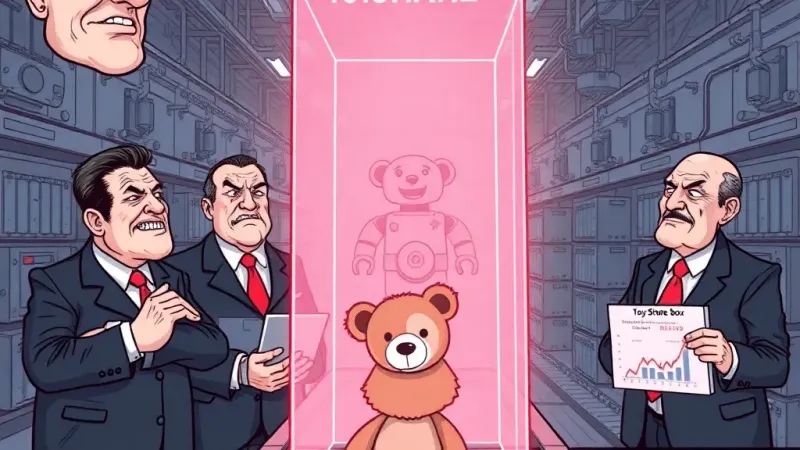
SAN CLEMENTE, CA – A seemingly innocuous "Take a Toy, Leave a Toy" box at Baby Beach has ignited a firestorm of economic analysis, with leading venture capitalists and market strategists hailing the humble wooden container as the prototype for the next trillion-dollar disruptive business model. The initiative, which allows beachgoers to exchange pre-loved playthings, is being lauded as a revolutionary advancement in circular consumption and decentralized resource allocation.
"We're looking at a pure, unadulterated micro-circular play economy with virtually zero customer acquisition cost and an entirely user-generated inventory pipeline," stated Dr. Thad McMillan, a Senior Partner at HyperGrowth Capital and co-author of the recent white paper "The Sandbox-to-Silicon Value Chain." Dr. McMillan’s firm is reportedly exploring a $200 million seed round for "ToyBox Global," a conceptual platform that would leverage blockchain-enabled QR codes to track the provenance and "play-value" depreciation of shared beach shovels and plastic trucks.
Not all analysts are uniformly bullish. "While the capital expenditure is remarkably low, at approximately $65 for lumber and paint, the scalability faces immediate friction," cautioned Brenda Sterling, a senior analyst at PlayMetrics Data Solutions. "There's currently no monetization strategy beyond the inherent joy of a child finding a new pail, which, frankly, isn't a strong enough EBITDA driver for our portfolio. And let's not ignore the significant 'sand-in-gear' ratio inherent to an outdoor, publicly accessible toy repository." Sterling highlighted concerns over inventory shrinkage and the lack of a premium subscription tier for early access to highly desirable items.
The rapid ascent of the "ToyBox" concept has, predictably, drawn the attention of regulatory bodies. The Federal Play Commission (FPC) is reportedly drafting guidelines on "toy-sharing best practices" and exploring potential anti-monopoly concerns should a single entity attempt to control the beach toy supply chain. Meanwhile, several non-profit foundations are lobbying for "Play Equity Zones," ensuring that underserved communities have equal access to spontaneously appearing, sand-filled plastic buckets. This burgeoning ecosystem is already generating specialized consultancies focused solely on "toy-flow optimization" and "micro-plastic value capture."
Industry pundits are already predicting "ToyBox-as-a-Service" (TBaaS) models, envisioning a future where every public space features an AI-optimized toy exchange, dynamically adjusting its offerings based on real-time child engagement data and parental spending habits. Early adopters are reportedly tracking sentiment on social media, with one viral tweet featuring a toddler happily exchanging a broken frisbee for a slightly less broken plastic boat accumulating over 1.7 million impressions and sparking multiple "think pieces" on the future of childhood ownership.
Despite the burgeoning interest from the financial sector, local parents reported that the box's primary function remains simply to provide a spare shovel when theirs gets lost, often filled with forgotten items from the previous weekend.