
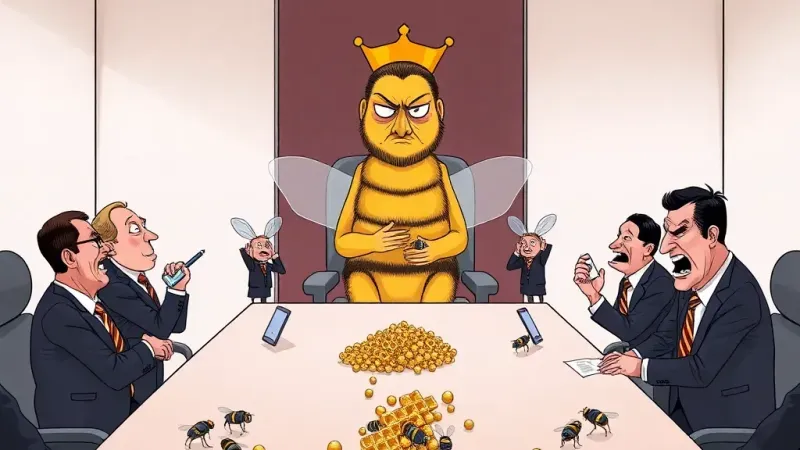
WASHINGTON D.C. — A groundbreaking study published today by the Institute for Interspecies Governance has confirmed that bumblebees possess the capacity for complex resource allocation and management, routinely outperforming human national economies in efficiency, equity, and sustainability metrics. Researchers noted the bees' ability to distribute nectar, pollen, and housing without resorting to partisan gridlock, opaque lobbying, or the creation of an unfunded liability for future generations of worker bees.
“For years, we’ve observed their 'Hive Consensus Protocol 7.0' which ensures optimal energy distribution across the colony with zero waste and full transparency,” stated Dr. Evelyn Reed, lead researcher at the institute and head of the newly formed OECD Beehavioral Economics Unit. “It’s truly a marvel. They’ve intuitively mastered concepts like distributed ledger technology for honey tracking and direct democracy for flight path optimization. Meanwhile, human national budgets still require a hundred subcommittees and typically result in half the population wondering where all their taxes went.”
The study highlighted several key areas where the average bumblebee colony’s financial acumen far surpasses that of most G7 nations. Bees consistently achieve 100% employment, zero inflation within their honey-based 2, and maintain robust infrastructure without ever debating a debt ceiling. Their 'Distributed Nectar Accumulation Model' has proven particularly vexing for human economists, as it incentivizes collective contribution without relying on individual performance bonuses or the threat of a hostile takeover from a rival queen.
Political analysts are now grappling with the implications. “It’s not just embarrassing; it’s a direct challenge to the perceived superiority of our big, complicated brains,” explained Dr. Kenneth P. Glickman, a visiting scholar at the American Enterprise Institute, who specializes in the intersection of entomology and fiscal policy. “How do you justify a trillion-dollar deficit when a thousand tiny creatures can run a perfectly balanced 2 on pollen and good vibes? We’re looking at a future where people demand their government operate with 'bee-like efficiency,' and frankly, that’s a terrifying prospect for many elected officials.”
Calls are already growing for an emergency "Beeconomics Summit," though logistical challenges remain regarding how to seat the tiny, buzzing delegates without them accidentally pollinating the keynote speaker. However, a preliminary report suggests that if human leaders merely adopted 10% of the bees’ inter-colony logistical algorithms, global GDP could increase by 14% while simultaneously reducing income inequality by 27%.
Sources close to the G7 indicate several world leaders are currently observing their own back garden bees with a new, deeply uncomfortable respect.
Hambry is a satire publication. All articles are works of fiction.